
Extreme flooding in the Southwest foreshadows a wild El Niño winter

The Southwest just got way too much of a good thing. Last weekend, a ferocious storm inundated communities and killed at least four people. Though precipitation is an essential component of Arizona’s desert climate, the state got two or three months’ worth of it in just a few days — far more than human infrastructure could handle all at once. Since September 20, an astonishing 28.84 inches of rain has fallen on Clovis, New Mexico, compared to its historical average of just 3.3 inches.

“This weekend was just adding more on the rough times that those communities in Southwest Colorado and Arizona and Utah and New Mexico have been having recently,” said Russ Schumacher, director of the Colorado Climate Center at Colorado State University, who’s also the state climatologist. “I think the El Niño connection is pretty clear.”

Indeed, that band of warm water in the Pacific could be priming much of the southern United States for a winter of increased precipitation, according to the National Oceanic and Atmospheric Administration’s seasonal outlook. “Could an event like this have happened in a non-El Niño year?” asked Michael A. Crimmins, a climatologist at the University of Arizona. “It could have, but it would have been a lot harder to pull all of the ingredients together at the same time, and would have been a lot less likely.”
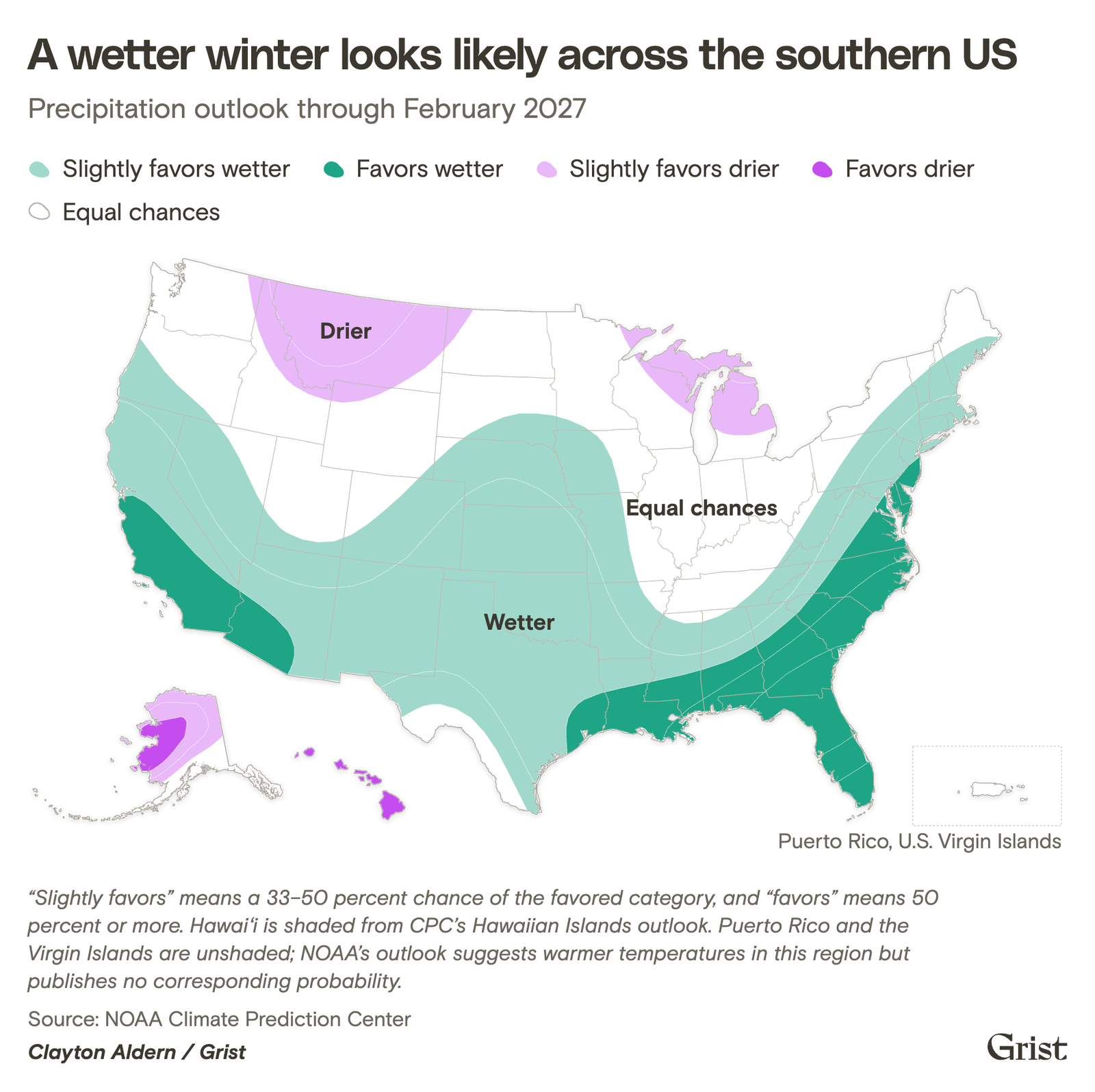
Map of NOAA’s precipitation outlook for December 2026 through February 2027. A wetter winter is favored from California to the Carolinas and up the East Coast, with a 70 to 80 percent chance in southeast Georgia and north Florida. Drier conditions are favored in Montana, the upper Great Lakes, western Alaska and Hawaiʻi.

A wetter winter looks likely across the southern US

Precipitation outlook through February 2027

Slightly favors wetterFavors wetterSlightly favors drierFavors drierEqual chances

WetterDrierEqual chancesPuerto Rico, U.S. Virgin Islands

The looming problem this winter is heat, oddly enough. The unfolding El Niño is already the strongest on record, and it could get stronger still in the next few months. Although that amounts to just a handful of extra degrees in the Pacific, it injects a tremendous amount of energy into the atmosphere, scrambling weather the world over. The phenomenon is so influential, in fact, that it has helped cancel hurricanes over in the Atlantic, by messing with winds high up in the atmosphere. Accordingly, this year shattered the record for the latest first hurricane in a season by nearly a month. Normally by this time of year we’d have seen six of these cyclones, but 2026 has still only produced one.

The Southwest, though, gets no such relief from inclement weather. In addition to adding heat to the sky, the warmer waters of El Niño also increase atmospheric moisture. Even beyond the El Niño, temperatures in the Pacific have been running extra hot, which explains why the western part of the ocean has produced 10 hurricanes this season even as the Atlantic has remained quiet. (Overall, more than 90 percent of the excess heat that humans have pumped into the atmosphere has been absorbed by the oceans.)

All this warm water means more moisture for the weather patterns that have been moving into the Southwest over the last month. A separate system in late October, for instance, became one of the most extreme storms in Colorado’s history, pelting higher elevations with up to 8 inches of rain in four days, causing widespread destruction. “It’s just really extreme amounts of water vapor in the atmosphere that have been aimed into the Southwest in each of those storms,” Schumacher said.

This autumn precipitation primed Arizona, Colorado, and other Southwestern states for yet more destruction this past week. For one, rivers were already running high, then ran all the higher. And two, if soils are soaked, a followup bout of rain will run off and cause flooding. “We get the second storm, just a little bit after the first one, then everything was primed for even worse flooding this time around,” Schumacher said. 
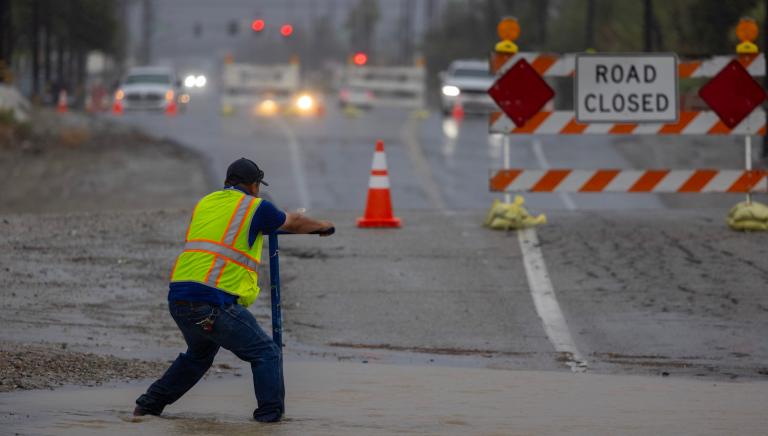
In mountainous terrain, this gets especially dangerous, as the topography funnels rainwater into raging torrents. “If you hike around the Southwest, you’re going to see out-of-place boulders all over the place,” Crimmins said. “Water put it there. Maybe it was 5,000 years ago or something like that, but water moves. We can have really epic flash flooding.”

The one silver lining here is that any increased precipitation from this El Niño could bring drought relief to much of the southern U.S., according to NOAA’s projections. Climate change is not only exacerbating these ongoing dry spells — hotter temperatures also increase evaporation from reservoirs. At the same time, populations are growing in the Southwest, meaning more people demanding more water. 

Map of NOAA’s seasonal drought outlook through January 31, 2027. Drought is expected to improve or end across much of the Southwest, the Southern Plains, the Southeast and parts of the East Coast. It is expected to persist across the northern Rockies and northern Plains and into Michigan, and to develop or worsen in western Montana and Idaho.

Drought could ease across the South this winter

Seasonal drought outlook through January 31, 2027

WorseningPersistingDevelopingImprovingEnding

Puerto Rico, U.S. Virgin Islands

With these factors conspiring, the Colorado River’s two largest reservoirs, Lake Powell and Lake Mead, are approaching the point of collapse. The potential for more rainfall this winter might help fill them, Schumacher said, but it can’t reverse the system’s precipitous decline. “It’s a long way to go to get even back to where we were a year ago,” he said. “Let alone when it was in good condition decades ago.”

The wildcard this year is snowpack: It’s still too early to tell, Schumacher said, how much snow will fall in Colorado. Whereas rainwater flows quickly into rivers, making it harder to store without overwhelming infrastructure — hence all the destructive flooding of late — snowpack slowly releases water as things thaw in the spring. With a record low snowpack earlier this year, Colorado is in desperate need of bountiful flakes in the months ahead.

Water agencies can’t change the weather, but they can at least change how they manage precipitation. Down in Arizona, cities like Tucson have been installing green infrastructure — basically dirt spaces that hydrate native plants — which slow down the flow of water, thus preventing flooding. “There’s really cool and clever ways of thinking about stormwater as a resource,” Crimmins said, “rather than a nuisance.”


Don’t miss these tips!

We don’t spam! Read more in our privacy policy

LEAVE A REPLY

Please enter your comment!
Please enter your name here

Hot this week

What are the animals in your home learning from each other?

LEARNING FROM EACH OTHER Leaf, Sunshine, and Cuddles The animals who...

A tiny squeeze dramatically changes the magnetism of exotic materials

Scientists at the Department of Energy's Oak Ridge National...

AI Is Thriving at Capital One

If one were making a list of the companies...

European summer ‘deadliest’ for heatwaves

This summer was Europe’s deadliest on record, with more...

How to actually block AI bots from scraping your website

Share this article Join the conversation Follow us Add us as a...

Topics

Related Articles

Popular Categories

News Feed

OpenAI wants to win over data-center opponents by calling them ‘compute campuses’ and promising local benefits

OpenAI has a new name for the loud, dull, gray buildings Americans don’t really want as their next-door neighbors, and it’s calling them “compute...

Nearly two-thirds of 2021’s top 100 altcoins have lost more than 90%, CoinMarketCap data shows

For anyone in crypto in 2021, the main risk felt like not owning any. The biggest altcoins looked like serious long-term bets: That November,...

Prediction markets had a great election night: Now bettors are turning to which Trump officials could leave first

Traders on prediction markets like Kalshi and Polymarket correctly favored Democrats to win both chambers of Congress, and proved highly accurate in forecasting several...

STAT+: Up and down the ladder: The latest comings and goings

Ed’s stories explore prescription drug pricing, affordability and access, as well issues surrounding patents, litigation, and legislation. He is also the author of the...

Tech layoffs November update: Job cuts hit workers at Amazon, Angi, Block, Canva, and Squarespace

Layoffs aren’t fun any time of year, but they can be especially hard when they come just before the holidays, raising anxieties about the...

Trump administration’s cap on student loans have borrowers turning to private lenders

New limits on federal student loans filled Chloe Frabotta with anxiety as she began studying in New York City to become a physician assistant.The...

Over a quarter of Gen Z say they’d choose their dream home over their dream job—and they’re moving back in with mom and dad...

Gen Zers are so desperate to get a home of their own they’re increasingly willing to make trade-offs—even if it means putting opportunities on...

Some Gen Z Trump voters switched sides over what one calls an ‘egregious betrayal’ on the economy and war

Ryan Wharton normally doesn’t vote. But at a low point last year, the 28-year-old PR professional and freelance journalist found himself cashing in his pennies...

STAT+: New tumor cases show common gene therapy tool can come with risk

For two decades, researchers debated whether adeno-associated viruses, the small viruses used to deliver new genes into thousands of patients, could in certain cases...

Billionaires Ray Dalio and Richard Branson hate workplace gossip—but men who do it could face a steeper career penalty than women, study finds

Men who gossip around the office watercooler could be hurting their chances of climbing the corporate ladder. That’s according to a new study by researchers...

Bill Gates believes a billionaire’s tax is the only option in the age of AI—and ‘whatever’s left over’ can be used as a philanthropic...

The stock rout of the past 24 hours may have wiped billions from the net worths of the world’s wealthiest people. Still, the hiccup...

Humoring Donald Trump is no longer tech’s biggest problem

Hello again, and welcome back to Fast Company’s Plugged In. It’s difficult to imagine human beings less similar in temperament than Donald Trump and most...

‘A master class in how to handle layoffs’: Canva is restructuring 22% of its workforce, and LinkedIn is applauding the exit package

Most layoff announcements draw anger. Canva’s is drawing applause. Co-founder and CEO Melanie Perkins announced on Tuesday that a sweeping restructuring will affect 1,271 employees,...

STAT+: Amgen’s Repatha linked to fewer heart attacks

Want to stay on top of the science and politics driving biotech today? Sign up to get our biotech newsletter in your inbox.Pithy intro text about...

Nepal seeks stronger recognition of mountain issues in UN climate process

In the wake of its recent glacial flooding disaster, Nepal and the kingdom of Bhutan have proposed a new agenda item on mountains and...

At an old steel site in Pittsburgh, bacteria evolved to survive – and eat – industrial pollution

by Catherine Armbruster, Carnegie Mellon University Across Appalachia and the Rust Belt region, including throughout the city of Pittsburgh, former industrial sites are being transformed...

Will even one of the U.N.’s 17 ‘sustainable development goals’ be met by 2030?

Read the full story from NPR. By any standards, it was an eye-popping to-do list. No poverty. Zero hunger. Quality education for all. Gender equality. Clean...

As climate disasters multiply, Indigenous governance offers a way forward

Read the full story at Grist. Indigenous communities are confronting mounting climate threats even as inadequate funding, scant legal recognition, and little support for self-governance...

STAT+: Pharmalittle: We’re reading about a Novartis gene therapy, faster U.K. drug reviews, and more

And so, another working week will soon draw to a close. Not a moment too soon, yes? This is, you may recall, our treasured...

Rapidly diverging public trust in science in the United States

Milkoreit, M., & Smith, E. K. (2025). Rapidly diverging public trust in science in the United States. Public Understanding of Science, 34(5), 616–627. https://doi.org/10.1177/09636625241302970...

Popular articles

OpenAI wants to win over data-center opponents by calling them ‘compute campuses’ and promising local benefits

OpenAI has a new name for the loud, dull, gray buildings Americans don’t really want as their next-door neighbors, and it’s calling them “compute...

Nearly two-thirds of 2021’s top 100 altcoins have lost more than 90%, CoinMarketCap data shows

For anyone in crypto in 2021, the main risk felt like not owning any. The biggest altcoins looked like serious long-term bets: That November,...

Prediction markets had a great election night: Now bettors are turning to which Trump officials could leave first

Traders on prediction markets like Kalshi and Polymarket correctly favored Democrats to win both chambers of Congress, and proved highly accurate in forecasting several...

STAT+: Up and down the ladder: The latest comings and goings

Ed’s stories explore prescription drug pricing, affordability and access, as well issues surrounding patents, litigation, and legislation. He is also the author of the...

Tech layoffs November update: Job cuts hit workers at Amazon, Angi, Block, Canva, and Squarespace

Layoffs aren’t fun any time of year, but they can be especially hard when they come just before the holidays, raising anxieties about the...

Trump administration’s cap on student loans have borrowers turning to private lenders

New limits on federal student loans filled Chloe Frabotta with anxiety as she began studying in New York City to become a physician assistant.The...

Over a quarter of Gen Z say they’d choose their dream home over their dream job—and they’re moving back in with mom and dad...

Gen Zers are so desperate to get a home of their own they’re increasingly willing to make trade-offs—even if it means putting opportunities on...

Some Gen Z Trump voters switched sides over what one calls an ‘egregious betrayal’ on the economy and war

Ryan Wharton normally doesn’t vote. But at a low point last year, the 28-year-old PR professional and freelance journalist found himself cashing in his pennies...

STAT+: New tumor cases show common gene therapy tool can come with risk

For two decades, researchers debated whether adeno-associated viruses, the small viruses used to deliver new genes into thousands of patients, could in certain cases...

Billionaires Ray Dalio and Richard Branson hate workplace gossip—but men who do it could face a steeper career penalty than women, study finds

Men who gossip around the office watercooler could be hurting their chances of climbing the corporate ladder. That’s according to a new study by researchers...

Bill Gates believes a billionaire’s tax is the only option in the age of AI—and ‘whatever’s left over’ can be used as a philanthropic...

The stock rout of the past 24 hours may have wiped billions from the net worths of the world’s wealthiest people. Still, the hiccup...

Humoring Donald Trump is no longer tech’s biggest problem

Hello again, and welcome back to Fast Company’s Plugged In. It’s difficult to imagine human beings less similar in temperament than Donald Trump and most...

‘A master class in how to handle layoffs’: Canva is restructuring 22% of its workforce, and LinkedIn is applauding the exit package

Most layoff announcements draw anger. Canva’s is drawing applause. Co-founder and CEO Melanie Perkins announced on Tuesday that a sweeping restructuring will affect 1,271 employees,...

STAT+: Amgen’s Repatha linked to fewer heart attacks

Want to stay on top of the science and politics driving biotech today? Sign up to get our biotech newsletter in your inbox.Pithy intro text about...

Nepal seeks stronger recognition of mountain issues in UN climate process

In the wake of its recent glacial flooding disaster, Nepal and the kingdom of Bhutan have proposed a new agenda item on mountains and...

At an old steel site in Pittsburgh, bacteria evolved to survive – and eat – industrial pollution

by Catherine Armbruster, Carnegie Mellon University Across Appalachia and the Rust Belt region, including throughout the city of Pittsburgh, former industrial sites are being transformed...

Will even one of the U.N.’s 17 ‘sustainable development goals’ be met by 2030?

Read the full story from NPR. By any standards, it was an eye-popping to-do list. No poverty. Zero hunger. Quality education for all. Gender equality. Clean...

As climate disasters multiply, Indigenous governance offers a way forward

Read the full story at Grist. Indigenous communities are confronting mounting climate threats even as inadequate funding, scant legal recognition, and little support for self-governance...

STAT+: Pharmalittle: We’re reading about a Novartis gene therapy, faster U.K. drug reviews, and more

And so, another working week will soon draw to a close. Not a moment too soon, yes? This is, you may recall, our treasured...

Rapidly diverging public trust in science in the United States

Milkoreit, M., & Smith, E. K. (2025). Rapidly diverging public trust in science in the United States. Public Understanding of Science, 34(5), 616–627. https://doi.org/10.1177/09636625241302970...