

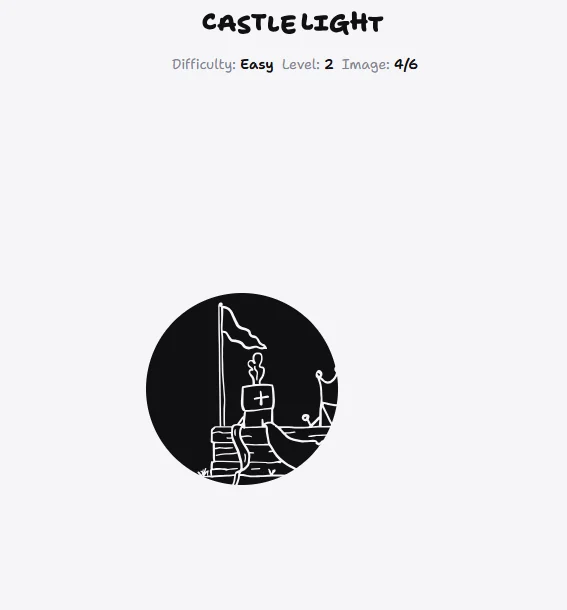
Teachers might or might not be aware of the “Zoom In’ instructional strategy. It typically means showing students a small part of an image, and then gradually showing them the rest of it. Sometimes I’ve had students draw on the whiteboard what they think the rest of a projected image looks like, along with making observations and asking questions.
In the last part of this post, I’ll paste what I think is a decent explanation of the strategy from ChatGPT.
But what prompted this post was my learning about a website called Castle Light.
It offers an interesting “take” on the Zoom In strategy. The site shares six images. With each one, you move around a circle that illuminates tiny portions of the image, and then you have to answer a question about it. It could be a fun game to play at the end of a period to promote language acquisition.
I’m adding this info to The Best Ways To Use Photos In Lessons.
Here’s ChatGPT’s description of Zoom-In:
Zoom-In Strategy
Students see a small portion of an image, then the teacher gradually reveals more of it. At each step students:
-
Observe carefully
-
Make predictions
-
Revise their thinking as more information appears
It’s widely used in ELL instruction, inquiry lessons, and social studies.
Other names you might hear
-
Reveal the Picture
-
Mystery Picture
-
Partial Picture Strategy
-
Slow Reveal
But “Zoom-In” is the term most often used in teaching resources and PD.
Why teachers use it
It encourages:
-
careful observation
-
academic language (“I think… because…”)
-
inference and evidence
-
student engagement
Example sequence
-
Show tiny corner of the image
-
Students guess what it might be
-
Reveal more
-
Students revise predictions
-
Continue until full image is shown
Many teachers use it before introducing a new unit or concept.
Here are three powerful variations of the Zoom-In strategy that work especially well with English learners and that many teachers use to deepen thinking.
Students must justify each prediction with evidence.
How it works
-
Show a small section of the picture.
-
Students predict what it might be.
-
They must use a sentence frame.
Sentence frames
-
I think this might be ___ because I see ___.
-
This detail suggests ___.
-
My prediction changed because now I see ___.
Why it works
ELL students practice:
-
academic language
-
evidence-based reasoning
-
revising ideas
Students look for objects or clues connected to key vocabulary.
Example
If the unit is about industrialization, students might look for:
-
machines
-
smoke
-
factories
-
workers
Procedure
-
Reveal a small part of the picture.
-
Students identify possible vocabulary connections.
-
Keep revising as more of the picture appears.
Language frame
-
This could relate to the word ___ because ___.
Great for content-based ELL instruction.
Students track how their thinking evolves.
Steps
Students keep a chart:
| Reveal | My Prediction | Evidence |
|---|---|---|
| 1 | Maybe a farm | I see grass |
| 2 | Maybe a factory | I see smoke |
| 3 | Industrial city | I see buildings |
Why this is powerful
Students learn:
-
predictions change
-
new evidence reshapes thinking
-
reasoning improves over time
This models historical thinking and scientific thinking.
The most effective Zoom-In images have:
-
multiple clues
-
ambiguity at first
-
clear reveal payoff
Examples teachers often use:
-
Dust Bowl photos
-
Ellis Island scenes
-
Civil Rights protests
-
factory interiors