
Scientists find deadly virus DNA hidden in 1,000-year-old manuscripts

image

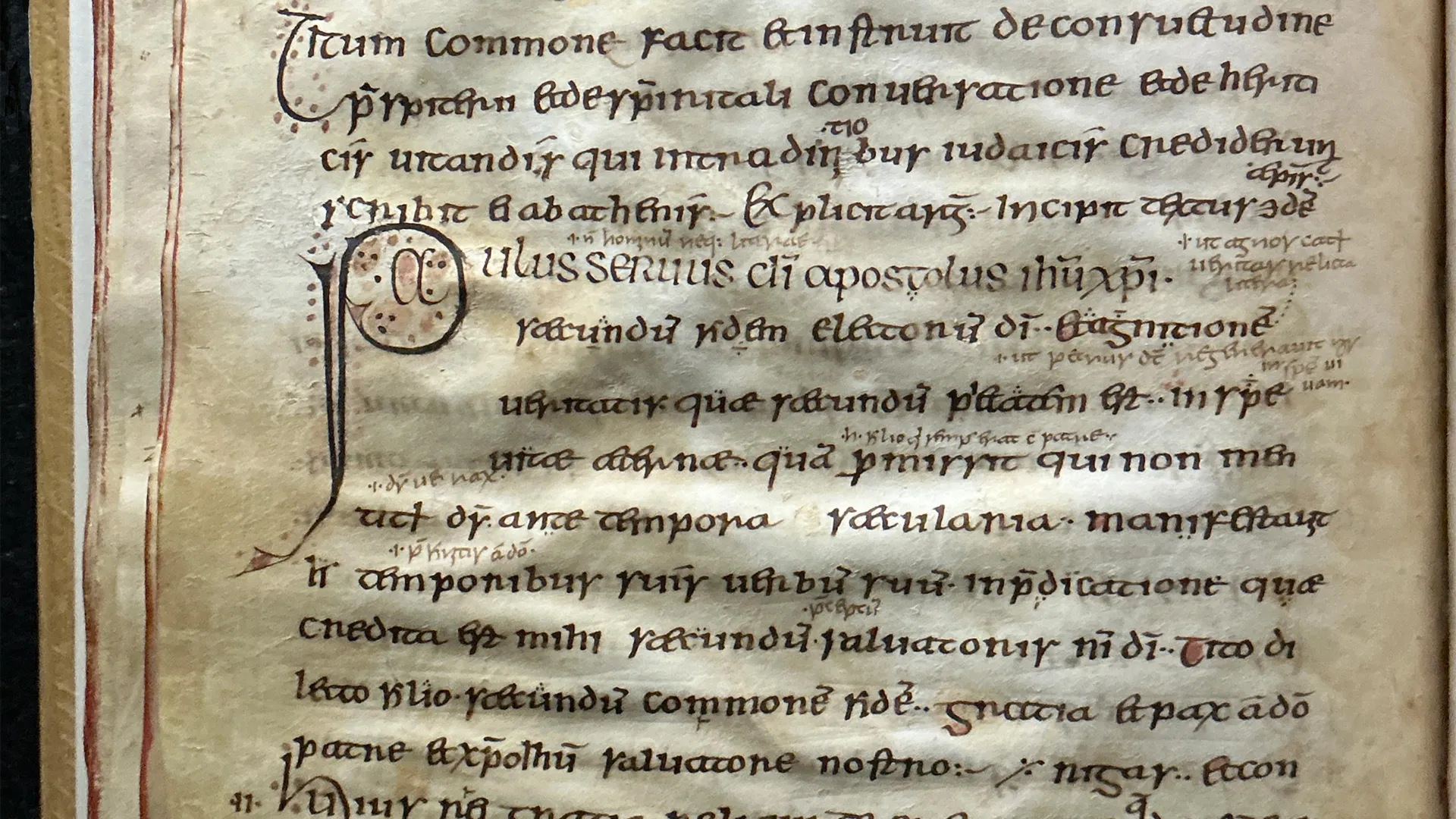
Some of Europe’s most famous medieval manuscripts, including the York Gospels, have revealed an extraordinary secret hidden in their pages. Scientists have discovered ancient viral DNA preserved in the animal skins used to make parchment, opening a new window into the 3,500-year history of sheeppox virus (SPPV).

The discovery was made by an international research team led by University College Dublin (UCD). By analyzing parchment from centuries-old documents, the researchers uncovered the first genetic evidence that this destructive disease was spreading through European sheep flocks long before modern times.

Sheeppox is highly contagious and can spread through a flock with alarming speed. It can kill large numbers of infected animals, particularly young sheep, while also causing major economic losses by reducing wool, meat, and milk production.

Ancient Manuscripts Preserve the DNA of Deadly Viruses

Published in Science Advances, the new study reconstructs more than 3,500 years of sheeppox virus evolution. Researchers identified viral DNA in several historically important medieval manuscripts, revealing that documents preserved for their cultural significance can also contain valuable biological evidence.

Among the manuscripts examined was the 1,000-year-old York Gospels, considered one of the finest surviving illuminated manuscripts from the early Anglo-Saxon period. The researchers also studied older works, including the Corpus Glossary at Corpus Christi College Cambridge, one of the earliest English dictionaries, along with other medieval manuscripts from Britain and continental Europe.

The secret lies in the parchment itself. Before paper became widely available, manuscripts were often produced using carefully prepared animal hides, including skins from sheep, goats, and cattle. These materials can preserve traces of an animal’s biological history, including evidence of infections present when it died.

In several manuscripts, the researchers detected sheeppox virus DNA on multiple pages. These findings indicate that infected animals had supplied some of the skins used to produce the documents.

An especially surprising discovery involved viral DNA found on parchment made from calfskin and goatskin. Because sheeppox primarily infects sheep, the results raise two possibilities: the virus may occasionally have infected other livestock species, or viral material may have contaminated the skins during parchment production.

Historic Books Become Unexpected Disease Archives

“The recording of ancient DNA of pathogens has completely changed our understanding of infectious disease in the past, and here we show that parchment can also preserve animal pathogen DNA. It is possible that archives and libraries around the world also contain the genetic traces of disease outbreaks in animals in the past,” said Louis L’Hôte, PhD candidate at UCD and lead author of the study.

“These genomes help us understand how these pathogens evolved and how they impacted past societies — such as sheeppox virus, which we show has been affecting Eurasian sheep herds for at least three and a half millennia.”

The findings suggest that libraries and archives may hold far more information about historical diseases than previously recognized. Manuscripts that have survived for hundreds of years could provide genetic evidence of livestock outbreaks that left few other records.

“Parchment making has been considered a vanishing craft, but we are beginning to understand just how much of the past it has retained. This project shows that parchments not only preserve our cultural history for hundreds of years, but also the landscape of disease in our livestock in the medieval period,” said Dr. Kevin G. Daly, Associate Professor at UCD School of Agriculture and Food Science and the study’s supervising author.

“This kind of exciting, surprising discovery is only possible when researchers from a range of disciplines come together to share their expertise and data — a generosity and trust that collaborative science depends on.”

The project brought together specialists in genetics, history, virology, protein chemistry, and conservation, allowing the team to investigate the manuscripts from both historical and biological perspectives.

Ancient Sheep Teeth Reveal 3,700 Years of Disease

The medieval manuscripts were only part of the investigation. To trace the disease further into the past, the scientists also examined DNA recovered from sheep teeth dating to the Bronze Age.

Teeth are particularly useful for studying ancient infections because they can protect genetic material for thousands of years, often preserving evidence that has disappeared from other skeletal remains.

The researchers identified the oldest known genetic traces of sheeppox virus in sheep teeth recovered from ancient pastoralist settlements in the Eurasian steppe. When combined with the manuscript findings, this evidence shows that the disease has affected livestock for more than 3,700 years.

To investigate how the virus developed, the team compared ancient viral DNA with genetic sequences from modern viruses. Their analysis suggests that the main branches of the capripoxvirus family (sheeppox virus, goatpox virus, and lumpy skin disease virus) separated from one another sometime between 11,500 and 3,700 years ago.

That estimated timeline coincides with major changes in human history, including the domestication of livestock and the large-scale movement of sheep from the Eurasian steppe into Europe. These movements may have played an important role in the virus’s long history of transmission.

A Deadly Virus That Has Barely Changed in Thousands of Years

One of the study’s most striking findings was how little the sheeppox virus has changed genetically over the past several thousand years. Unlike some other viruses, its genome appears to have remained remarkably stable despite its long history of infecting livestock.

Understanding that stability could help scientists identify the genetic changes that originally allowed the virus to become an effective sheep pathogen.

The discovery also has immediate relevance. Sheeppox remains a serious threat to livestock farming, with outbreaks continuing to cause substantial economic damage.

“People around the world are still fighting against this pathogen — there is currently an outbreak of sheeppox in Greece, causing much economic damage,” said Louis L’Hôte.

“Ancient genomes can help us understand how these pathogens affecting us today evolved. We find that unlike the smallpox virus, the sheeppox virus genome was very stable over the last few millennia.”

L’Hôte added: “This might mean that genetic changes before this point were very important to how the sheeppox virus evolved to infect its host, which may help us fight the pathogen in the future.”

By uncovering viral DNA in both medieval manuscripts and prehistoric animal remains, the researchers have demonstrated a powerful new way to investigate the history of infectious diseases. Their work suggests that materials preserved for entirely different purposes may contain valuable clues about the emergence, spread, and evolution of pathogens that continue to affect the world today.

The research was funded by Taighde Éireann-Research Ireland and the European Research Council. Led by UCD, the project involved more than 30 institutions in Ireland and internationally, including Trinity College Dublin, the Helmholtz Institute for One Health, Université Paris 1 Panthéon-Sorbonne, the University of Leicester, Cambridge University, and the University of Copenhagen.

Don’t miss these tips!

We don’t spam! Read more in our privacy policy

LEAVE A REPLY

Please enter your comment!
Please enter your name here

Hot this week

Topics

Related Articles

Popular Categories

News Feed

Jensen Huang agrees to testify before Congress

Ex-Nvidia CEO Jensen Huang has agreed to testify before Congress, House Foreign Affairs Committee Chairman Brian Mast said on Thursday, according to reports from...

Five ways Jensen Huang’s ouster from Nvidia could damage the AI industry

Nvidia CEO Jensen Huang’s confession that he had an affair (and reports of another one with a direct report) that led the board to...

Measles Reaches a New Peak, Thanks to RFK Jr. and His Opposition to Vaccines

When Lyndon B. Johnson was President in the late 1960s, opponents of the war in Vietnam used to taunt him with this phrase when...

Whoop just launched a social network

Whoop, the maker of screen-less fitness bands, is launching a social network on Thursday that lets its members follow friends and family and share...

Jensen Huang is out at Nvidia — who is Colette Kress, his interim replacement?

The Nvidia Board of Directors announced on Thursday morning that the company’s co-founder and CEO of 33 years, Jensen Huang, has resigned as president,...

Norwest pushes deeper into AI with new $4B fund

Norwest, a firm backed solely by Wells Fargo, has raised a $4 billion fund as it sets out to invest more in AI. This...

If the November Windows update fails to install on your PC, here’s what to do

ZDNET’s key takeaways The November Windows update may fail to install on some PCs. People who installed the preview update seem to be affected. Microsoft is rolling...

Cyberattack on Fireworks AI allowed hackers to access Notion customers’ chat transcripts

A cyberattack at Fireworks AI has exposed some of its customers’ data, the company has confirmed. Fireworks AI, a platform that developers use to...

Nancy Bailey: Discovery Learning or Direct Instruction?

Veteran educator Nancy Bailey knows that the “science of reading” movement has promoted a zeal for “direct instruction,” an approach to teaching that relies...

Safer healthcare substitution needs life-cycle evidence: Lessons from the post-amalgam transition

Mikulewicz, M., & Chojnacka, K. (2026). Safer healthcare substitution needs life-cycle evidence: Lessons from the post-amalgam transition. Environmental Science & Technology, 60(40), 28150–28152. https://doi.org/10.1021/acs.est.6c13088 Abstract Replacing...

‘Nature-based’ solutions could save insurers and policyholders billions

Read the full story at Inside Climate News. Wetlands restoration and wildfire prevention can drive down insurers’ costs and skyrocketing premiums, a new study shows. See...

More than 1,200 Colorado students have earned a climate ‘seal’: ‘We’re the ones growing up in this world’

Read the full story in The Guardian. A statewide initiative pairs climate-focused coursework with community service – and is spreading to other states.

How a reluctant Iowa farming county undid a ban on battery storage

Read the full story at Canary Media. Three brothers wanted to use some land for solar, batteries, and cattle grazing. First they had to convince...

Researchers offer three ways to alert users to AI hallucinations with ‘embodied’ agents

Read the full story from North Carolina State University. When a conversational AI character in an immersive environment says something false, how should the system...

Texas used to be ‘the best place’ to build data centers—but not anymore

Read the full story at Inside Climate News. Pushback on data centers has forced developers to seek out community permission, something the industry largely hadn’t...

We blasted mobile homes with hurricane‑force winds to test how they fail – and found clues for making affordable housing safer

by Elaina Sutley, University of Kansas and Arindam Chowdhury, Florida International University It’s 9:15 in the morning. The wind is roaring at 110 miles per...

A note from Re:Create: Making sense of the OpenAI amicus avalanche

Read the full post at Re:Create. For folks watching the AI litigation horizon for signs and portents of the future of fair use (it’s not...

Amid Iowa’s water crisis, factory farms get a pass on environmental permitting

Read the full story at Inside Climate News. More than a decade after the EPA found that Iowa wasn’t cracking down on polluting factory farms,...

Chemical identification and environmental fate of fluorescein during celebratory surface water dyeing: A field evaluation in the Chicago River

Getzinger, G. J., & Duffee, L. H. (2026). Chemical identification and environmental fate of fluorescein during celebratory surface water dyeing: A field evaluation in...

The green revolution may be turning purple

Read the full story at Anthropocene Magazine. The fertilizers that feed humanity are made in huge pressure cookers, heated to 450°C (840°F), in factories that...

Years after storms, clean-up crews meticulously separate the sentimental from the wreckage

Read the full story from NPR. As debris cleanup becomes a troubling reality for more and more disaster survivors, there’s a growing network of people...

Popular articles

Jensen Huang agrees to testify before Congress

Ex-Nvidia CEO Jensen Huang has agreed to testify before Congress, House Foreign Affairs Committee Chairman Brian Mast said on Thursday, according to reports from...

Five ways Jensen Huang’s ouster from Nvidia could damage the AI industry

Nvidia CEO Jensen Huang’s confession that he had an affair (and reports of another one with a direct report) that led the board to...

Measles Reaches a New Peak, Thanks to RFK Jr. and His Opposition to Vaccines

When Lyndon B. Johnson was President in the late 1960s, opponents of the war in Vietnam used to taunt him with this phrase when...

Whoop just launched a social network

Whoop, the maker of screen-less fitness bands, is launching a social network on Thursday that lets its members follow friends and family and share...

Jensen Huang is out at Nvidia — who is Colette Kress, his interim replacement?

The Nvidia Board of Directors announced on Thursday morning that the company’s co-founder and CEO of 33 years, Jensen Huang, has resigned as president,...

Norwest pushes deeper into AI with new $4B fund

Norwest, a firm backed solely by Wells Fargo, has raised a $4 billion fund as it sets out to invest more in AI. This...

If the November Windows update fails to install on your PC, here’s what to do

ZDNET’s key takeaways The November Windows update may fail to install on some PCs. People who installed the preview update seem to be affected. Microsoft is rolling...

Cyberattack on Fireworks AI allowed hackers to access Notion customers’ chat transcripts

A cyberattack at Fireworks AI has exposed some of its customers’ data, the company has confirmed. Fireworks AI, a platform that developers use to...

Nancy Bailey: Discovery Learning or Direct Instruction?

Veteran educator Nancy Bailey knows that the “science of reading” movement has promoted a zeal for “direct instruction,” an approach to teaching that relies...

Safer healthcare substitution needs life-cycle evidence: Lessons from the post-amalgam transition

Mikulewicz, M., & Chojnacka, K. (2026). Safer healthcare substitution needs life-cycle evidence: Lessons from the post-amalgam transition. Environmental Science & Technology, 60(40), 28150–28152. https://doi.org/10.1021/acs.est.6c13088 Abstract Replacing...

‘Nature-based’ solutions could save insurers and policyholders billions

Read the full story at Inside Climate News. Wetlands restoration and wildfire prevention can drive down insurers’ costs and skyrocketing premiums, a new study shows. See...

More than 1,200 Colorado students have earned a climate ‘seal’: ‘We’re the ones growing up in this world’

Read the full story in The Guardian. A statewide initiative pairs climate-focused coursework with community service – and is spreading to other states.

How a reluctant Iowa farming county undid a ban on battery storage

Read the full story at Canary Media. Three brothers wanted to use some land for solar, batteries, and cattle grazing. First they had to convince...

Researchers offer three ways to alert users to AI hallucinations with ‘embodied’ agents

Read the full story from North Carolina State University. When a conversational AI character in an immersive environment says something false, how should the system...

Texas used to be ‘the best place’ to build data centers—but not anymore

Read the full story at Inside Climate News. Pushback on data centers has forced developers to seek out community permission, something the industry largely hadn’t...

We blasted mobile homes with hurricane‑force winds to test how they fail – and found clues for making affordable housing safer

by Elaina Sutley, University of Kansas and Arindam Chowdhury, Florida International University It’s 9:15 in the morning. The wind is roaring at 110 miles per...

A note from Re:Create: Making sense of the OpenAI amicus avalanche

Read the full post at Re:Create. For folks watching the AI litigation horizon for signs and portents of the future of fair use (it’s not...

Amid Iowa’s water crisis, factory farms get a pass on environmental permitting

Read the full story at Inside Climate News. More than a decade after the EPA found that Iowa wasn’t cracking down on polluting factory farms,...

Chemical identification and environmental fate of fluorescein during celebratory surface water dyeing: A field evaluation in the Chicago River

Getzinger, G. J., & Duffee, L. H. (2026). Chemical identification and environmental fate of fluorescein during celebratory surface water dyeing: A field evaluation in...

The green revolution may be turning purple

Read the full story at Anthropocene Magazine. The fertilizers that feed humanity are made in huge pressure cookers, heated to 450°C (840°F), in factories that...

Years after storms, clean-up crews meticulously separate the sentimental from the wreckage

Read the full story from NPR. As debris cleanup becomes a troubling reality for more and more disaster survivors, there’s a growing network of people...