

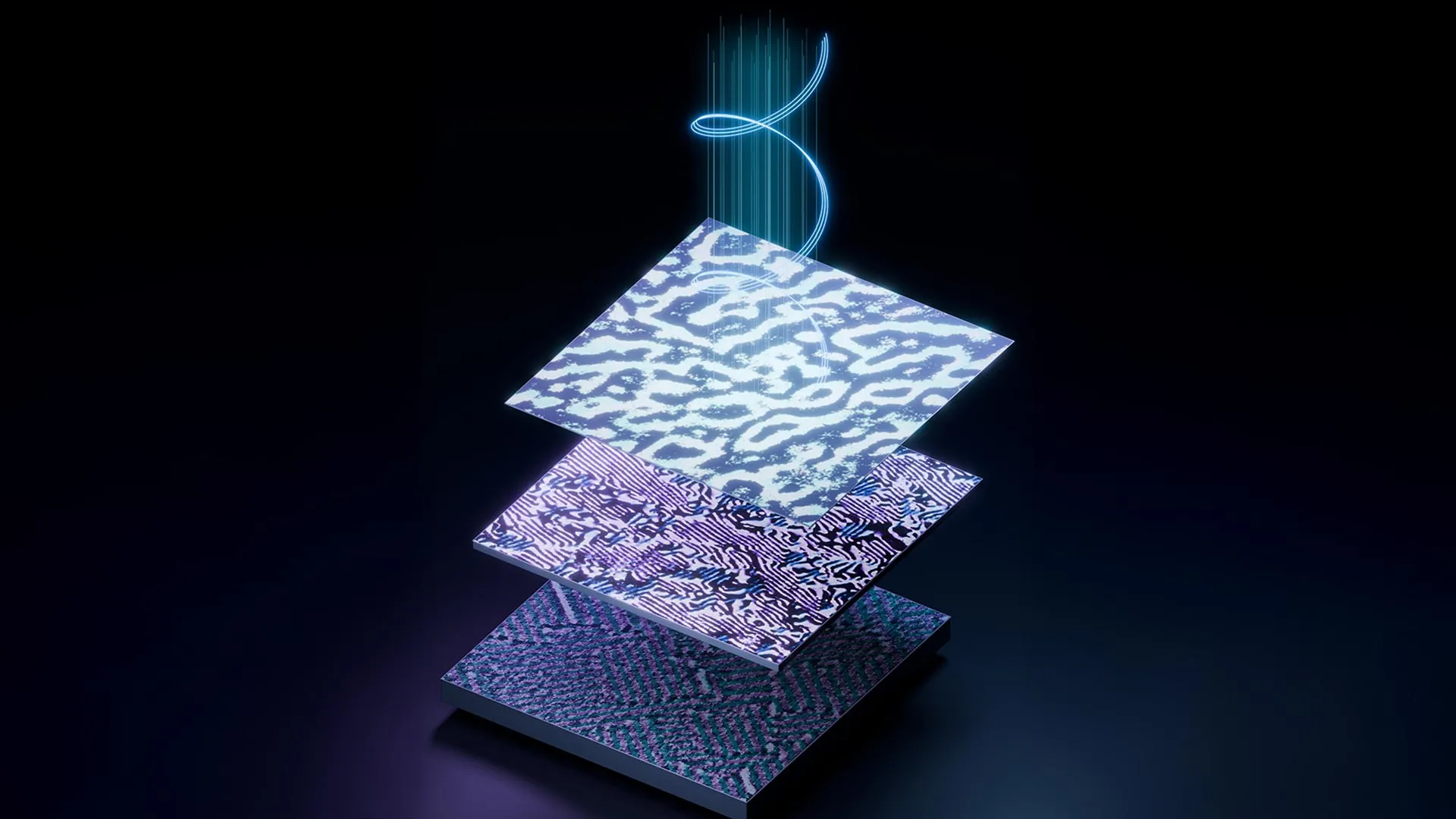
A promising new approach to building computer chips could dramatically reduce the energy needed for computing, including the rapidly growing demands of artificial intelligence. At the center of the breakthrough is a special class of materials known as multiferroics, which combine electrical and magnetic properties that can be controlled together using extremely small voltages.
These materials could make future electronics far more energy efficient than today’s technology. However, a major obstacle has prevented their use in conventional computer chips. When multiferroics are made thin enough to fit inside these devices, they typically lose the electrical and magnetic behavior that makes them valuable. Scientists call this problem the “dead layer” effect.
Researchers at Brown University have now developed a way to overcome this limitation. Their technique produces extremely thin films of bismuth ferrite, a widely studied multiferroic material, without sacrificing its essential properties. Even more remarkably, the process gives the material new magnetic characteristics that could make it especially useful for future electronics.
“We’ve established that we can get rid of the dead layer,” said Lucas Caretta, an assistant professor of engineering at Brown who led the work. “We show that you can make this material basically as thin as you want — down to a few angstroms — and it’s still ferroelectric, and it’s still magnetic.”
The findings were published in the journal Nature Materials.
Why Multiferroics Could Transform Computer Chips
What makes multiferroics so attractive for computing is the unusual connection between their electrical and magnetic properties. Their atomic structure is made up of repeating units in which positive and negative charges are positioned on opposite sides, creating a property known as electrical polarization.
Applying a small voltage can reverse this polarization, effectively switching the positions of the positive and negative charges. This provides a potential way to store digital information as binary values (ones and zeros) using very little electricity.
Because the material’s magnetic behavior is linked to its electrical polarization, the stored information can also be retrieved magnetically. This combination could enable computer memory and logic components that require significantly less energy than existing technologies.
The challenge has been making these materials small enough for practical devices. Modern computer chips require exceptionally thin layers, but multiferroics traditionally stop functioning properly when reduced to such dimensions.
Two separate effects cause this breakdown. First, the material’s atomic structure becomes distorted, disrupting the arrangement and chemical environment necessary for its properties to function. Second, internal electric fields interfere with the material’s polarization until it can no longer be maintained. Together, these effects destroy both its ferroelectric and magnetic behavior, creating the troublesome dead layer.
How Brown Engineers Eliminated the Dead Layer
To solve the problem, the Brown University team developed a new method for producing thin films of bismuth ferrite.
The researchers deposited the material onto a foundation made of dysprosium scandate, a compound derived from rare earth elements. This underlying material has a crystal structure with slightly smaller dimensions than bismuth ferrite, creating a mismatch between their atomic arrangements.
That mismatch places the bismuth ferrite under compression, helping preserve the atomic structure required for its electrical and magnetic properties to remain intact.
The team also incorporated a second metallic layer designed to counteract unwanted electric fields. By preventing those fields from disrupting the material’s electrical polarization, the additional layer addresses the other major cause of the dead layer effect.
Together, these changes allow the bismuth ferrite film to retain its multiferroic properties even when reduced to just a few angstroms in thickness.
But the researchers discovered something else. Rather than simply preserving the material’s original capabilities, their approach actually improved its magnetic behavior.
An Unexpected Form of Magnetism
The engineered layers caused the bismuth ferrite to exhibit altermagnetism, an unusual form of magnetism that combines useful characteristics of two more familiar magnetic states: ferromagnetism and antiferromagnetism.
This discovery could be particularly important for developing faster and more compact computer components.
“Ferromagnets are useful for memory and logic because they produce strong magnetic signals that are easy to read out,” Caretta said. “The challenge is that they are relatively slow, and their stray magnetic fields make it difficult to pack devices densely on a chip without interference. Antiferromagnets can operate much faster and avoid those stray fields, but their signals are much harder to detect. Altermagnets are kind of the best of both worlds — they can be fast, densely integrated and still provide a strong electrical signal for readout.”
In other words, altermagnets offer a potentially valuable combination of speed, compactness, and readable signals. These characteristics could help engineers build computer components that operate efficiently without the interference problems associated with conventional magnetic materials.
The ability to create this magnetic behavior in an exceptionally thin multiferroic film makes the discovery especially promising for future chip designs.
A New Path Toward Energy-Efficient AI Computing
As artificial intelligence continues to drive demand for computing power, developing hardware that consumes less electricity has become an increasingly important goal.
Caretta believes the new findings could help bring multiferroic materials closer to practical use in low-power memory and computing devices. Although the technology still needs further development before it can be incorporated into commercial chips, the research demonstrates that a long-standing materials limitation can be overcome.
It also shows that carefully engineering a material’s atomic environment can do more than preserve its existing properties. Under the right conditions, it can produce useful behavior that was not present in the original material.
“We know the underlying properties are already there in the bulk materials,” Caretta said. “The trick is learning how to engineer them into a form that’s useful — and sometimes even better than what nature gives us.”
The research received funding from the U.S. Army Research Office (W911NF-21-2-0162), the National Science Foundation (DMR-2039380, OIA-2327352) and the U.S. Department of Energy (DE-AC02-05CH11231).