

“Club Kid” Is a Disarming Cocktail of Grit and Fantasy
Early on in “Club Kid,” an exuberantly entertaining comedy from the writer and director Jordan Firstman, an Uber pulls up outside a Manhattan night club and, like an app-summoned clown car, disgorges an unruly load of human cargo. There’s Peter Green (Firstman), a scruffy, dark-haired man in his twenties; his flinty-eyed business partner, Sophie (Cara Delevingne); and several other friends, all of them pumped to drink, dance, and do ketamine bumps into the wee hours. Peter and Sophie work as party promoters within the city’s queer-club scene, tasked with scheduling events, booking d.j.s, and overseeing guest lists. As they stride up to the venue, the camera sweeping alongside them, Peter sets to work; he sizes up the long line, pulls in someone he recognizes, and then loses himself in the crowd. Watching him work the room, chat with other partygoers, and dance up a storm, you get the sense of a guy who mixes business and pleasure in unsustainable proportions—and who looks out for others better, perhaps, than he looks out for himself.
“Club Kid” is Firstman’s filmmaking début, and he proves as skilled a ringmaster behind the camera as Peter is inside a night club. The movie exudes a startling confidence, at once buoyant and grounded—the kind of assurance that can emerge when a young director’s grasp of the medium, however nascent, is in synch with his feel for his characters and their world. The film’s giddy opening moments fall into a tradition of New York movies that sweep us up, in a disorienting, intoxicating blur, into the city’s after-hours enclaves. Following Peter through this strobe-lit hothouse, you might flash back to “Anora” (2024), which laid bare the fleshy delights of a strip club with a mercantile matter-of-factness. (The two films share a producer, Alex Coco.) All the scenes at Peter’s parties have a touch of an underground sociology lesson. The uninitiated in the audience will learn a thing or two about which drugs to take and not to take, and they may also pick up some irreverent, up-to-the-minute slang: a cocaine-ketamine cocktail is described, at one point, as “a little Charlie, a little Kirk.” Through it all, Peter looks after the guests, most of them gay men and trans women, with a disarming show-you-a-good-time assurance. He isn’t above having a good time himself, even when it pushes against his own boundaries. When Leonora (Paris Petitjean), a British cisgender woman, comes on to him on the dance floor, he tells her that he’s “never touched a vagina in my life.” There’s a first time for everything, and Leonora pulls Peter and another guy into a drug-addled threesome. For Peter, it’s the most random of sex acts, and also the most consequential.
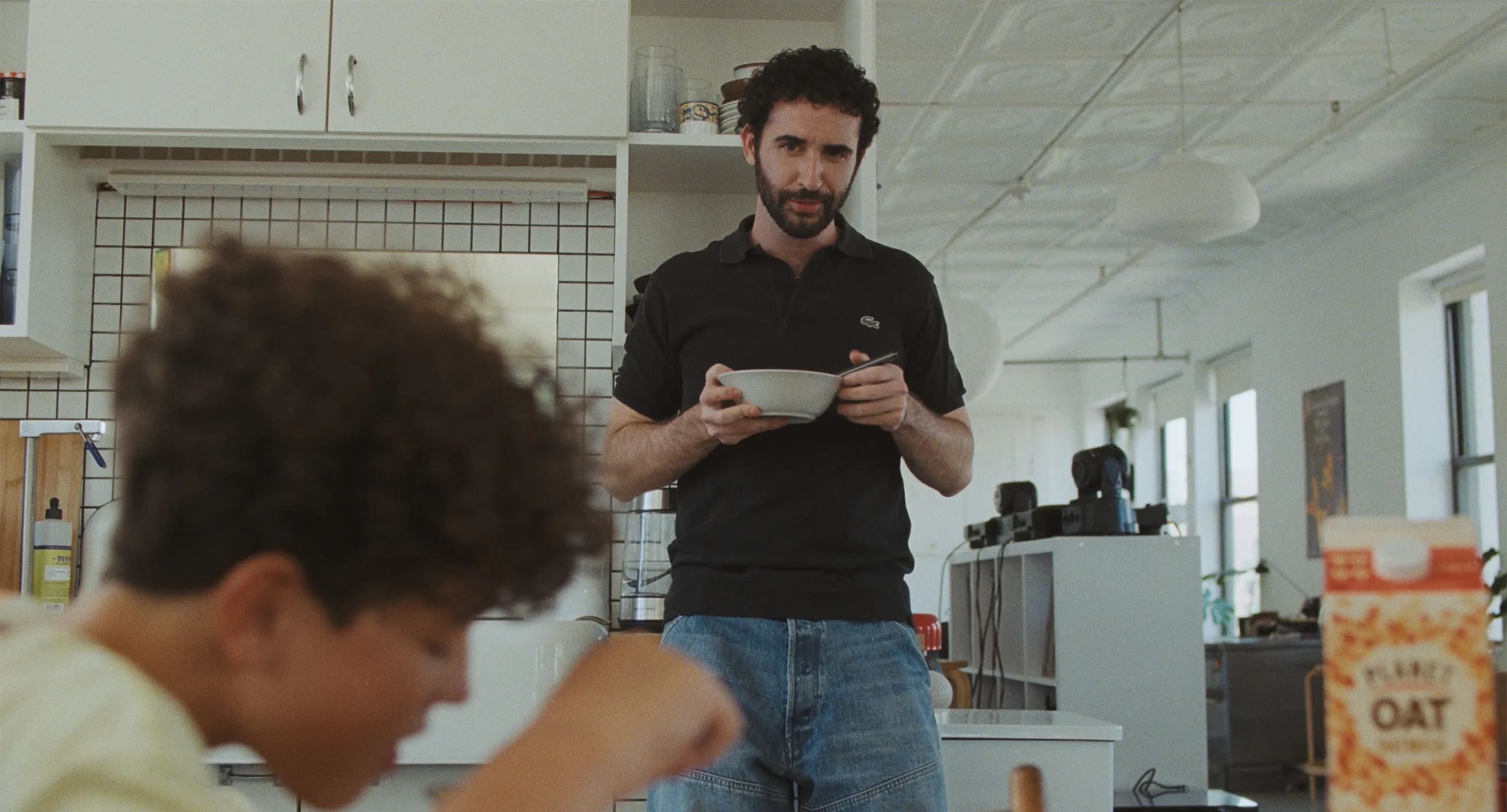
Cut to a decade or so later: Peter returns one day to his apartment, in Brooklyn, and finds a ten-year-old boy named Arlo (Reggie Absolom) waiting for him. Arlo, who has a springy mop of hair and soulful eyes, is the biological son Peter never knew he had. Until recently, the boy was living with his mother, in London. But Leonora has recently died, and apparently Peter is the only person in a position to step up and look after the boy. We hear all this from Leonora’s hard-partying friend Edison (Kirby Howell-Baptiste), rattling off the details with a motormouthed wit that succeeds in selling us on the rather tortured soap-opera plot she’s recapping. Although Peter’s name is on Arlo’s birth certificate, a harder-edged script—or a more cynical protagonist—might have insisted on a paternity test. But “Club Kid” cuts to the quick, with a good-vibes breeziness that, arguably, bespeaks a deeper honesty—a silent contract established with the viewer about the story they’re being told and the pleasures that it will provide. From the moment the kid shows up, there’s little doubt where we’re headed: Arlo is Peter’s, Peter is Arlo’s, and their long-overdue encounter is the film’s raison d’être.
The potential narrative obstacle, then, has less to do with plausibility than predictability. The odd-couple pairing of an adorable moppet and an unlikely guardian, biologically related or not, is among the hoariest of movie formulas, but also the most versatile: sometimes you get “The Game Plan,” a Dwayne Johnson football-and-fatherhood vehicle, from 2007, and sometimes you get a classic like John Cassavetes’s “Gloria,” from 1980. But the specifics of milieu can provide their own novelty, and Firstman’s delirious immersion in queer-club culture proves a threefold triumph—a source of atmosphere, comic mileage, and dramatic tension alike. For Peter, a decade’s worth of semi-lucrative hedonism has taken its toll, and he now stumbles through his days in what feels like a perpetual hangover. His working relationship with Sophie has frayed, money is scarce, and he deals drugs to help cover the rent—the same substances that have battered his mind and body. (“NO MORE DRUGS. THEY DO NOT FEEL GOOD ANYMORE,” he types into his phone after an especially rough night.)
An unexpected shot at fatherhood is both the last thing Peter needs and, in the movie’s unsurprising yet wholly enjoyable formulation, the best thing that’s ever happened to him. Arlo is a living, breathing incentive for Peter to get healthy and sober and figure out, just in time, what to do with his life. It helps that Arlo, winningly played by Absolom, is smart, easygoing, and startlingly well-adjusted for a child who hasn’t enjoyed the stablest of childhoods. Edison mentions an abusive boyfriend of Leonora’s, and there is one scene, set at a public park, where some of Arlo’s suppressed trauma flares violently into the open. Other than that, the most inconvenient thing about him is a dairy allergy. What he’s absorbed from Leonora is a passion for music and a preternatural ease around the club scene that, in every sense, spawned him. No wonder Peter, cash-strapped as he is, can’t resist spending three hundred bucks on an Elliott Smith vinyl record that catches his son’s eye. And no wonder Arlo clicks so quickly with Saffron, a transgender d.j. who shows him the track-spinning ropes.
Saffron is played by Saturn Risin9, one of several nonprofessional actors, including Alaska Riley, whom Firstman recruited from New York’s L.G.B.T.Q.+ party scene, and who infuses the picture with raucous energy and sustained warmth. Not every character comes fully into focus, but among the most quietly vivid is a guy named Devon (the actor and comedian Nigil Whyte), who can applaud Peter’s embrace of fatherhood one moment and wax poetic about the joys of fisting the next. However unlikely it might seem, Peter has been an intuitive fit for his new role all along. Taking care of others, and fostering family within a community, has always come more naturally to him than he realizes.
Firstman’s first several years in the entertainment industry have been their own journey of loopy self-discovery. After getting his start as a writer on the HBO series “Search Party” and as a director of short films, he became an internet star during the COVID-19 pandemic, when several of his comedy videos went viral. When I attended the Independent Spirit Awards in February, 2020, I had no idea that it was Firstman who had written one of the show’s best bits, a hilarious musical tribute to non-obvious examples of gayness in recent movies. (“The title of the film ‘Diane,’ ” the Gay Men’s Chorus of Los Angeles intoned solemnly, “Octavia Spencer playing a history teacher,” and then crescendoed into a multi-film lovefest for Laura Dern.) Years later, Firstman weighed in more sharply on queer representation when he pointed out that the sex scenes in “Heated Rivalry,” the hit series about closeted hockey players, were “not how gay people fuck.” (Amid considerable backlash, he swiftly apologized for the comment.)
Before “Club Kid,” Firstman’s most prominent film role was in “Rotting in the Sun” (2023), a comic mystery thriller that featured some gleefully unsimulated demonstrations of how gay people fuck. His performance had a cheekily meta streak: he played a social-media-influencer type named Jordan Firstman—a fatuous, often full-frontal narcissist who was revealed, in one of the film’s sweeter, slyer twists, to be a figure of surprising intelligence and loyalty, someone you couldn’t help but root for. My sense at the time was that he had a healthy awareness of the obnoxiousness of his own persona and an impressive ability to manipulate and even subvert it. In “Club Kid,” he has us fully on his side from the start. Peter, for all his poor choices, is never as exasperating as he is likable, and he’s never more likable than when he realizes, with shock, how much Arlo means to him.
The film is a wondrous fusion: comedy blurs almost imperceptibly into drama, and realism becomes almost interchangeable with fantasy. In a moment of pure wish fulfillment—which is to say, a classic rom-com trope—Peter takes Arlo to see a social worker (Diego Calva), who turns out to be the dreamiest love interest imaginable: sensitive, gorgeous, and in desperate need of an education in the films of Gregg Araki. But wish fulfillment has its limits, and the canniness of the movie lies in its precise understanding of when and where those limits fall. When Peter reluctantly allows Arlo to d.j. at a party, it’s both an irresponsible risk and a glorious success—and Firstman, refusing to deny either aspect of the experience, uses it to bring father and son to an inevitable point of crisis. There’s a brief battle for Arlo’s future, conducted without ill motives or rancor from anyone, and blessed with a performance, as Peter’s attorney, by Vicki Pepperdine. Her presence confirms that Firstman has cast the movie with care, down to the smallest roles. The film ends with one last punctuating burst of laughter, with a lingering aftertaste of wistfulness and hope. Every club kid must grow up, Peter very much included. ♦