
Russia’s Kaliningrad threats show the value of Baltic preparedness

This post was originally published on this site.

Russia’s Kaliningrad threats show the value of Baltic preparedness
Expert comment
jon.wallace

Moscow’s nuclear rhetoric should be taken seriously. But Baltic states know grey zone attacks and territorial incursions are equally serious threats.

Vladimir Putin always chooses his words carefully. If Russia faced a direct attack on Kaliningrad (its enclave on the Baltic Sea), he warned on 1 October, the use of ‘all weapons in (our) country’s arsenal’ would inevitably be on the table. 

The statement followed an earlier Russian note to NATO, threatening nuclear escalation if the alliance were to isolate Kaliningrad. NATO, thus far, has responded with restraint. Secretary General Mark Rutte said there was no imminent Russian threat and rebuffed Moscow’s nuclear rhetoric. But this skirmishing has pushed Kaliningrad – and NATO’s Baltic borders with Russia – back into the spotlight. 

Kaliningrad is not just any territory for the Russians. At the Yalta and Potsdam conferences of 1945, Soviet leader Stalin asserted his claim to what was then known as Königsberg. It was, he said, necessary for Russia to have at least ‘one ice-free port’ at the expense of Germany. The US and UK consented, and Moscow gained a permanent military position on the Baltic Sea. 

After the collapse of the Soviet Union and the withdrawal of the Baltic states to become independent democracies, Kaliningrad’s geographical isolation from Russia became more apparent, creating one of the most peculiar pieces of land on the continent. Today the enclave hosts Russia’s Baltic Fleet, missile systems and combat aircraft. 

Since Russia’s full-scale invasion of Ukraine in 2022, the surrounding geopolitics has changed. Finland and Sweden are now part of NATO. Poland is rearming at unprecedented speed. And the military presence across the alliance’s north-eastern flank is much denser. Meanwhile, Lithuania may soon vote to lift a ban on hosting nuclear weapons on its territory – a move the Kremlin described on 6 October as ‘a step towards escalating tensions’.

Kaliningrad remains a key forward position for Russia. But its near-complete isolation, in the middle of a more coherent NATO Baltic presence, presents Moscow with a serious geostrategic and military challenge.

Denying Russia a quick victory

One glance at the map is enough to understand that Estonia, Latvia and Lithuania have but little strategic depth. The three states depend heavily on the Suwałki corridor – a 65km strip of land between Kaliningrad and Belarus that connects Poland and Lithuania – for overland reinforcement. Reclaiming territory from an attacker would be an unlikely option for Baltic countries.
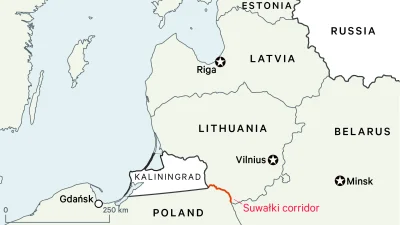
Map showing Kaliningrad in the region.

—

Made with Natural Earth data.

The only credible alternative is to make a Russian advance difficult from the beginning. ‘We have to start from the border and win from the first battles,’ Colonel Tarmo Kundla, commander of the Estonian First Brigade, recently declared.

That is the purpose of the Baltic Defence Line along the eastern border: bunkers, anti-tank obstacles and other defensive outposts. Estonia plans hundreds of squad-level bunkers. A permanently deployed German armoured brigade will become operational in Lithuania in 2027. And Finland now hosts a NATO Forward Land Force. Defence spending across the region has risen far beyond NATO’s old two-per-cent target to reach nearly 5.5 per cent in the case of Estonia.

The intention is clear. Russia must be deterred from any attempt to seize even a small amount of territory – a significant possibility if Russia were to test NATO resolve. 

Preparedness before the first bullet is shot

But Baltic defence measures are about more than spending commitments and defending their Russian borders. Baltics countries know that to deter Russia it is just as vital to stress test their critical infrastructure and train their societies to keep functioning if and when a crisis emerges. Indeed, there is a lot the rest of the continent could learn from Baltic states’ whole-of-society model, which seeks to prepare their entire populations for an era of high-threat risk. 

Estonia, Latvia and Lithuania have accelerated preparations for grey zone conflict of the kind in which Russia excels, including attacks on infrastructure.

From Finland to Lithuania, this model consists of embedding all the layers of society in defence and preparedness strategies. This form of ‘comprehensive security’ is grounded in the belief that keeping the country functioning in a crisis is a shared responsibility of government, business, civil society and citizens. In this regard, the Baltics are the most strategically advanced in Europe.

Estonia, Latvia and Lithuania have accelerated preparations for grey zone conflict of the kind in which Russia excels, including attacks on infrastructure. All three have disconnected their electricity systems from Russian and Belarusian networks, progressively synchronizing them with the continental grid since February 2025. In the meantime, NATO has increased protection of Baltic undersea infrastructure, following damaged cables and various incidences of suspected sabotage. 

Slowly learning

Europe’s larger military powers are awaking to the need to somehow follow the Baltic lead and prepare their societies for an enlarging spectrum of threats. Germany, which would serve as one of NATO’s main logistical hubs in any reinforcement of the Baltic region, saw much of its civil-defence architecture fall into disrepair after the fall of the Berlin Wall. 

Its shelter capacity, for instance, now covers only around 480,000 people. Last spring Berlin approved a new €10-billion civil-defence programme, including plans to convert underground car parks, tunnels and stations into emergency shelters – evidence of renewed political engagement.

France has tested its armed forces at scale in the Orion 26 high-intensity exercise, which brought together 12,500 troops, 24 allied nations and civilian institutions in a scenario ranging from hybrid attacks to large-scale conventional war. The UK has developed a 2026 resilience plan that explicitly acknowledges growing Russian sub-threshold attacks. And the government is considering a reserve-style home-defence force to protect critical infrastructure. 

These are important changes. But ‘E3’ countries are still struggling to jointly improve resilience in transport, healthcare, energy, and communications – even as the risk of an enemy trying to disrupt all of them at once grows.

NATO is moving to drive the task forward. Its newly released resilience baseline requirements ask governments to plan for large movements of populations alongside military deployments; to develop health systems that can function even in case of mass casualties; and to develop communications and transport networks that can continue supporting allied forces during high-intensity conflict. In the near future, these will become the pillars on which deterrence actually depends.

Baltic gaps

Still, resilience won’t be enough alone to vanquish an enemy attack on the region. Baltic air and missile defence remains rather thin considering the scale of Russia’s drone and missile arsenal. Reinforcements would still have to reach the region through corridors like the Suwałki gap. And Russia would seize any opportunity to disrupt such movements. Fundamentally, Estonia, Latvia and Lithuania remain reliant on their larger allies’ ability to swiftly provide additional forces and air power in the event of a significant attack.

This makes Stalin’s ‘ice-free port’ of Kaliningrad more than an isolated flashpoint on the Baltic shores. Putin’s nuclear rhetoric deserves to be taken seriously. Russia revised its nuclear doctrine in 2024, explicitly broadening the circumstances in which Moscow could consider nuclear use. These include threats to its territorial integrity and attempts to isolate parts of the Russian territory. 

But the military geography surrounding the enclave has changed too. Once referred to as NATO’s most exposed flank, the Baltics have become much harder to intimidate, and harder still to overrun before NATO can respond. 
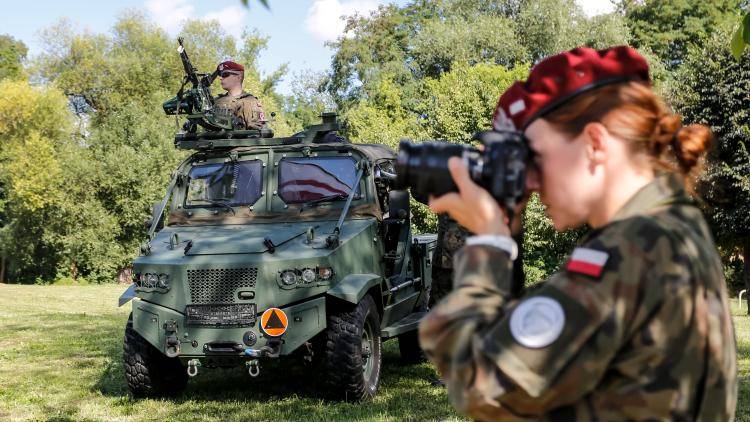
Their experience also carries a wider lesson for Europe: strategic weight is not measured by size alone, even that of a nuclear arsenal. Agility, civil preparedness and political resolve have allowed small states, free and democratic since 1991, to alter the terms of deterrence at their border. 

They have shown Europe that resilience begins long before deterrence fails and that it can change the enemy’s calculation. Their measures will make any attack look potentially far slower and costlier than Moscow would once have believed. Perhaps most significantly after the blatant failure of Russian objectives in Ukraine, Baltic resilience makes overall success of a military attack look far less certain for Vladimir Putin.

Don’t miss these tips!

We don’t spam! Read more in our privacy policy

LEAVE A REPLY

Please enter your comment!
Please enter your name here

Hot this week

What are the animals in your home learning from each other?

LEARNING FROM EACH OTHER Leaf, Sunshine, and Cuddles The animals who...

AI Is Thriving at Capital One

If one were making a list of the companies...

A tiny squeeze dramatically changes the magnetism of exotic materials

Scientists at the Department of Energy's Oak Ridge National...

25+ Must-Haves for Any SPED Teacher

Being a special education teacher is tough, but so...

How to actually block AI bots from scraping your website

Share this article Join the conversation Follow us Add us as a...

Topics

What are the animals in your home learning from each other?

LEARNING FROM EACH OTHER Leaf, Sunshine, and Cuddles The animals who...

AI Is Thriving at Capital One

If one were making a list of the companies...

A tiny squeeze dramatically changes the magnetism of exotic materials

Scientists at the Department of Energy's Oak Ridge National...

What Do The Election Results Mean For Education?

Schäferle / Pixabay It was a great election night, and...

Catedral Gótica

The Lisbon trio trades the laid-back feel of its...

Related Articles

Popular Categories

News Feed

At an old steel site in Pittsburgh, bacteria evolved to survive – and eat – industrial pollution

by Catherine Armbruster, Carnegie Mellon University Across Appalachia and the Rust Belt region, including throughout the city of Pittsburgh, former industrial sites are being transformed...

Will even one of the U.N.’s 17 ‘sustainable development goals’ be met by 2030?

Read the full story from NPR. By any standards, it was an eye-popping to-do list. No poverty. Zero hunger. Quality education for all. Gender equality. Clean...

As climate disasters multiply, Indigenous governance offers a way forward

Read the full story at Grist. Indigenous communities are confronting mounting climate threats even as inadequate funding, scant legal recognition, and little support for self-governance...

Rapidly diverging public trust in science in the United States

Milkoreit, M., & Smith, E. K. (2025). Rapidly diverging public trust in science in the United States. Public Understanding of Science, 34(5), 616–627. https://doi.org/10.1177/09636625241302970...

That fresh cleaning smell could be filling your home with nanoparticles

Read the full story from the American Chemical Society. Researchers found that scented cleaners can react with ozone indoors to create billions or trillions of...

The world has a new plan to save nature, but it still needs the money

Read the full story at Ars Technica. The world is set to miss its 2030 conservation goals as finance and action have fallen short, leaders...

Want your photos to survive for decades? A digital archivist explains what to do

Read the full story at PC World. Ina-Maria Jansson is a researcher and archivist at Uppsala University Library and works on the preservation of personal...

The locations of North Carolina’s industrial poultry farms have been a secret—until now

Read the full story at Inside Climate News. …three environmental nonprofits, CleanAIRE Carolina, Rural Empowerment Association for Community Help and the N.C. Environmental Justice Network,...

18 adorable winners from the Dog Photography Awards

Read the full story and see the photos at PetaPixel. The winners of the Dog Photography Awards 2026 have been announced, a contest that seeks...

Alabama’s new data center rules still leave customers in the dark, critics say

Read the full story at Inside Climate News. Nearly all observers agree that Alabama’s new data center policies released this week are an improvement over...

Investors are ignoring the biggest source of data-center water use

Read the full story at Trellis. Most of a data center’s water is consumed at the power plant that supplies it, but financiers screen mainly...

5 more ways to repurpose an old Kindle

Read the full story at How To Geek. There are plenty of things you can do with an old Kindle, from loading it with children’s...

Where opposition to data centers and renewable energy projects converge

Read the full story at Inside Climate News. Some of the arguments against data centers sound familiar. Opponents say the projects will change the look and...

A 2,500-year-old ski? The melting alps release ancient secrets.

Read the full story in the New York Times (gift article). The Alps are losing ice faster than almost anywhere on the planet. And, as...

The humble tree hole turns out to be a remarkable climate refuge

Read the full story at Anthropocene Magazine. Just as humans head indoors for warmth in the winter and shade in the summer, tree-dwelling animals use...

Big tech lost the election. Now comes the gaslighting.

Read the full story at The Lever. As Democrats prepare to investigate Silicon Valley, its liberal-branded lobby is scrambling to erase voters’ resounding rejection of...

Meet the Leader: Lynsey Scott of Kiche

Read the full interview at Meet the Leader. See also kitchen hacks for reducing food waste on the Kiche website. The co-founder and co-CEO of...

Katherine Ryan reacts to Russell Brand guilty verdict after ‘predator’ claims

Katherine Ryan has expressed her ‘grief and relief’ after Russell Brand was found guilty of rape and sexual assault. The disgraced comedian, 51, stood...

Popular articles

At an old steel site in Pittsburgh, bacteria evolved to survive – and eat – industrial pollution

by Catherine Armbruster, Carnegie Mellon University Across Appalachia and the Rust Belt region, including throughout the city of Pittsburgh, former industrial sites are being transformed...

Will even one of the U.N.’s 17 ‘sustainable development goals’ be met by 2030?

Read the full story from NPR. By any standards, it was an eye-popping to-do list. No poverty. Zero hunger. Quality education for all. Gender equality. Clean...

As climate disasters multiply, Indigenous governance offers a way forward

Read the full story at Grist. Indigenous communities are confronting mounting climate threats even as inadequate funding, scant legal recognition, and little support for self-governance...

Rapidly diverging public trust in science in the United States

Milkoreit, M., & Smith, E. K. (2025). Rapidly diverging public trust in science in the United States. Public Understanding of Science, 34(5), 616–627. https://doi.org/10.1177/09636625241302970...

That fresh cleaning smell could be filling your home with nanoparticles

Read the full story from the American Chemical Society. Researchers found that scented cleaners can react with ozone indoors to create billions or trillions of...

The world has a new plan to save nature, but it still needs the money

Read the full story at Ars Technica. The world is set to miss its 2030 conservation goals as finance and action have fallen short, leaders...

Want your photos to survive for decades? A digital archivist explains what to do

Read the full story at PC World. Ina-Maria Jansson is a researcher and archivist at Uppsala University Library and works on the preservation of personal...

The locations of North Carolina’s industrial poultry farms have been a secret—until now

Read the full story at Inside Climate News. …three environmental nonprofits, CleanAIRE Carolina, Rural Empowerment Association for Community Help and the N.C. Environmental Justice Network,...

18 adorable winners from the Dog Photography Awards

Read the full story and see the photos at PetaPixel. The winners of the Dog Photography Awards 2026 have been announced, a contest that seeks...

Alabama’s new data center rules still leave customers in the dark, critics say

Read the full story at Inside Climate News. Nearly all observers agree that Alabama’s new data center policies released this week are an improvement over...

Investors are ignoring the biggest source of data-center water use

Read the full story at Trellis. Most of a data center’s water is consumed at the power plant that supplies it, but financiers screen mainly...

5 more ways to repurpose an old Kindle

Read the full story at How To Geek. There are plenty of things you can do with an old Kindle, from loading it with children’s...

Where opposition to data centers and renewable energy projects converge

Read the full story at Inside Climate News. Some of the arguments against data centers sound familiar. Opponents say the projects will change the look and...

A 2,500-year-old ski? The melting alps release ancient secrets.

Read the full story in the New York Times (gift article). The Alps are losing ice faster than almost anywhere on the planet. And, as...

The humble tree hole turns out to be a remarkable climate refuge

Read the full story at Anthropocene Magazine. Just as humans head indoors for warmth in the winter and shade in the summer, tree-dwelling animals use...

Big tech lost the election. Now comes the gaslighting.

Read the full story at The Lever. As Democrats prepare to investigate Silicon Valley, its liberal-branded lobby is scrambling to erase voters’ resounding rejection of...

Meet the Leader: Lynsey Scott of Kiche

Read the full interview at Meet the Leader. See also kitchen hacks for reducing food waste on the Kiche website. The co-founder and co-CEO of...

Katherine Ryan reacts to Russell Brand guilty verdict after ‘predator’ claims

Katherine Ryan has expressed her ‘grief and relief’ after Russell Brand was found guilty of rape and sexual assault. The disgraced comedian, 51, stood...