
Scientists discover mysterious seahorse lookalikes that no one has ever seen alive

image

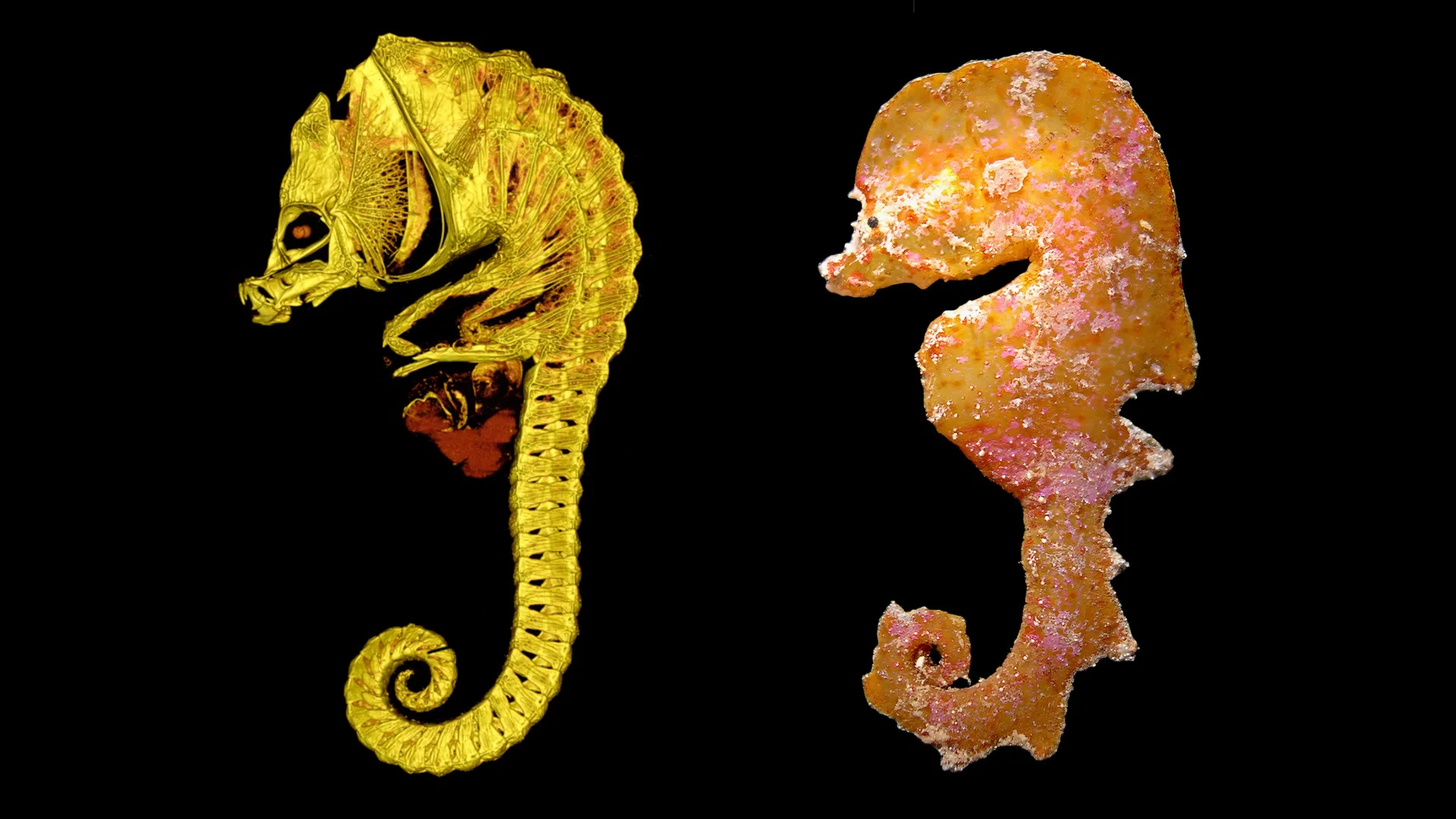
At first glance it looks exactly like a seahorse. It has the same horse-shaped head tilted down from the body, the same curled and grasping tail, and in the males a fully enclosed pouch for brooding the young.

But this little fish, no longer than your thumb, is not a seahorse, as we report in our new study published in the Journal of Lost Species. This is Australyichthys aegis, a newly described fish from the deep reefs off southern Australia. We have given it the common name helmethead sea muppet, after the domed, helmet-like crest on its head.

Its scientific name follows the same idea: in Greek mythology the aegis was a protective shield. Together with its two relatives, the bullneck sea muppet (A. minotaur) and the paradoxical sea muppet (A. paradoxus), it makes up a small group we nickname the sea muppets.

All three, we have now shown, belong on their own branch of the family tree. The seahorse look has arisen more than once, and these fish are a case of it evolving well away from the true seahorses. That evidence had been sitting in museum drawers, misfiled, for decades.

Bycatch from the deep

You will not find these fish while scuba diving.

Every known specimen was brought up by accident, caught in trawl nets or dredges working the seafloor between about 50 and 125 meters down. The single specimen of A. aegis came up in 2006 near the Gambier Islands, at the mouth of South Australia’s Spencer Gulf.

The dredge that caught it was sampling for small shelled animals known as brachiopods during a natural history expedition. Because that expedition was after invertebrates, the fish was mistakenly catalogued into the invertebrate collection of the South Australian Museum, where it sat unrecognized for years.

After each chance capture the fish were preserved, then largely forgotten. The rest are held in Australian museum collections, among them the Australian Museum, Museums Victoria and CSIRO.

The whole genus is known from just seven specimens gathered over about 65 years, scattered across more than 2,500 kilometers of coastline, and nothing has been collected in nearly two decades.

Irreplaceable specimens

The specimens are irreplaceable, so we could not dissect them. Instead we used micro-CT scanning, the same X-ray technology used in hospitals but fine enough to resolve tiny bones.

That let us build three-dimensional models of each fish’s skeleton and compare them bone by bone with true seahorses (Hippocampus).

Every earlier assessment had rested on external appearance, and the skeletons did not support it. Seahorses have a particular internal architecture, including a rigid cage of fused bony plates supporting the belly and a bony crown, called a coronet, on the head.

Our scans showed that Australyichthys has neither. In their place is a different arrangement of bones supporting the belly, one that appears in no seahorse.

Only one specimen could give us DNA.

A. aegis had been fixed in ethanol rather than formalin, the only member of the genus stored that way, and ethanol leaves genetic material intact. Sequencing it placed the fish well outside the seahorses, on the branch that is their closest relative. The genes said what the bones had already said.

All three species had been placed in the seahorse genus on the strength of how they look, and on that evidence they were seahorses. They are not, and they needed a genus of their own. We named it Australyichthys, from the Latin for southern and the Greek for fish.

A shared way of life

When separate lineages evolve to look alike, biologists call it convergent evolution, and it usually reflects a shared way of life rather than shared ancestry.

The whole seahorse body, with its bent head, gripping tail and brood pouch, has been built at least twice within a single fish family, the Syngnathidae, which includes seahorses, pipefishes, pipehorses and seadragons.

Working out how that happened may reveal why evolution keeps arriving at the same solution.

All this happened along the Great Southern Reef, the connected system of kelp forests and rocky reefs that rings southern Australia. Many of its species are found nowhere else, and its deeper zones are barely explored.

In fact, an entire genus of vertebrate hid there, misidentified, until a CT scanner settled the question.

No one has ever seen one of these fish alive; they have turned up only by chance in a passing net or dredge. On that record they now qualify as lost species, known from a handful of preserved animals and never from a living one.

Calling them lost is not a prediction of extinction. It marks them as a priority for targeted surveys that go looking rather than waiting for the next accidental catch. They are most likely still down there, in a part of the sea we hardly ever visit.

Don’t miss these tips!

We don’t spam! Read more in our privacy policy

LEAVE A REPLY

Please enter your comment!
Please enter your name here

Hot this week

What are the animals in your home learning from each other?

LEARNING FROM EACH OTHER Leaf, Sunshine, and Cuddles The animals who...

AI Is Thriving at Capital One

If one were making a list of the companies...

A tiny squeeze dramatically changes the magnetism of exotic materials

Scientists at the Department of Energy's Oak Ridge National...

How to actually block AI bots from scraping your website

Share this article Join the conversation Follow us Add us as a...

Are Crows and Parrots Really the Smartest Birds?

Kelsey McCune wanted to study smart birds, so naturally,...

Topics

What are the animals in your home learning from each other?

LEARNING FROM EACH OTHER Leaf, Sunshine, and Cuddles The animals who...

A tiny squeeze dramatically changes the magnetism of exotic materials

Scientists at the Department of Energy's Oak Ridge National...

AI Is Thriving at Capital One

If one were making a list of the companies...

‘Caligula’ Director Tinto Brass Dies at 93

The Italian filmmaker was best known for his hardcore...

17 better ways Elon Musk could have wasted $446 million

He’s not even good at being rich!He’s not even...

European summer ‘deadliest’ for heatwaves

This summer was Europe’s deadliest on record, with more...

Related Articles

Popular Categories

News Feed

Nepal seeks stronger recognition of mountain issues in UN climate process

In the wake of its recent glacial flooding disaster, Nepal and the kingdom of Bhutan have proposed a new agenda item on mountains and...

At an old steel site in Pittsburgh, bacteria evolved to survive – and eat – industrial pollution

by Catherine Armbruster, Carnegie Mellon University Across Appalachia and the Rust Belt region, including throughout the city of Pittsburgh, former industrial sites are being transformed...

Will even one of the U.N.’s 17 ‘sustainable development goals’ be met by 2030?

Read the full story from NPR. By any standards, it was an eye-popping to-do list. No poverty. Zero hunger. Quality education for all. Gender equality. Clean...

As climate disasters multiply, Indigenous governance offers a way forward

Read the full story at Grist. Indigenous communities are confronting mounting climate threats even as inadequate funding, scant legal recognition, and little support for self-governance...

Rapidly diverging public trust in science in the United States

Milkoreit, M., & Smith, E. K. (2025). Rapidly diverging public trust in science in the United States. Public Understanding of Science, 34(5), 616–627. https://doi.org/10.1177/09636625241302970...

That fresh cleaning smell could be filling your home with nanoparticles

Read the full story from the American Chemical Society. Researchers found that scented cleaners can react with ozone indoors to create billions or trillions of...

The world has a new plan to save nature, but it still needs the money

Read the full story at Ars Technica. The world is set to miss its 2030 conservation goals as finance and action have fallen short, leaders...

Want your photos to survive for decades? A digital archivist explains what to do

Read the full story at PC World. Ina-Maria Jansson is a researcher and archivist at Uppsala University Library and works on the preservation of personal...

The locations of North Carolina’s industrial poultry farms have been a secret—until now

Read the full story at Inside Climate News. …three environmental nonprofits, CleanAIRE Carolina, Rural Empowerment Association for Community Help and the N.C. Environmental Justice Network,...

18 adorable winners from the Dog Photography Awards

Read the full story and see the photos at PetaPixel. The winners of the Dog Photography Awards 2026 have been announced, a contest that seeks...

Alabama’s new data center rules still leave customers in the dark, critics say

Read the full story at Inside Climate News. Nearly all observers agree that Alabama’s new data center policies released this week are an improvement over...

Investors are ignoring the biggest source of data-center water use

Read the full story at Trellis. Most of a data center’s water is consumed at the power plant that supplies it, but financiers screen mainly...

5 more ways to repurpose an old Kindle

Read the full story at How To Geek. There are plenty of things you can do with an old Kindle, from loading it with children’s...

Where opposition to data centers and renewable energy projects converge

Read the full story at Inside Climate News. Some of the arguments against data centers sound familiar. Opponents say the projects will change the look and...

A 2,500-year-old ski? The melting alps release ancient secrets.

Read the full story in the New York Times (gift article). The Alps are losing ice faster than almost anywhere on the planet. And, as...

The humble tree hole turns out to be a remarkable climate refuge

Read the full story at Anthropocene Magazine. Just as humans head indoors for warmth in the winter and shade in the summer, tree-dwelling animals use...

Big tech lost the election. Now comes the gaslighting.

Read the full story at The Lever. As Democrats prepare to investigate Silicon Valley, its liberal-branded lobby is scrambling to erase voters’ resounding rejection of...

Meet the Leader: Lynsey Scott of Kiche

Read the full interview at Meet the Leader. See also kitchen hacks for reducing food waste on the Kiche website. The co-founder and co-CEO of...

Popular articles

Nepal seeks stronger recognition of mountain issues in UN climate process

In the wake of its recent glacial flooding disaster, Nepal and the kingdom of Bhutan have proposed a new agenda item on mountains and...

At an old steel site in Pittsburgh, bacteria evolved to survive – and eat – industrial pollution

by Catherine Armbruster, Carnegie Mellon University Across Appalachia and the Rust Belt region, including throughout the city of Pittsburgh, former industrial sites are being transformed...

Will even one of the U.N.’s 17 ‘sustainable development goals’ be met by 2030?

Read the full story from NPR. By any standards, it was an eye-popping to-do list. No poverty. Zero hunger. Quality education for all. Gender equality. Clean...

As climate disasters multiply, Indigenous governance offers a way forward

Read the full story at Grist. Indigenous communities are confronting mounting climate threats even as inadequate funding, scant legal recognition, and little support for self-governance...

Rapidly diverging public trust in science in the United States

Milkoreit, M., & Smith, E. K. (2025). Rapidly diverging public trust in science in the United States. Public Understanding of Science, 34(5), 616–627. https://doi.org/10.1177/09636625241302970...

That fresh cleaning smell could be filling your home with nanoparticles

Read the full story from the American Chemical Society. Researchers found that scented cleaners can react with ozone indoors to create billions or trillions of...

The world has a new plan to save nature, but it still needs the money

Read the full story at Ars Technica. The world is set to miss its 2030 conservation goals as finance and action have fallen short, leaders...

Want your photos to survive for decades? A digital archivist explains what to do

Read the full story at PC World. Ina-Maria Jansson is a researcher and archivist at Uppsala University Library and works on the preservation of personal...

The locations of North Carolina’s industrial poultry farms have been a secret—until now

Read the full story at Inside Climate News. …three environmental nonprofits, CleanAIRE Carolina, Rural Empowerment Association for Community Help and the N.C. Environmental Justice Network,...

18 adorable winners from the Dog Photography Awards

Read the full story and see the photos at PetaPixel. The winners of the Dog Photography Awards 2026 have been announced, a contest that seeks...

Alabama’s new data center rules still leave customers in the dark, critics say

Read the full story at Inside Climate News. Nearly all observers agree that Alabama’s new data center policies released this week are an improvement over...

Investors are ignoring the biggest source of data-center water use

Read the full story at Trellis. Most of a data center’s water is consumed at the power plant that supplies it, but financiers screen mainly...

5 more ways to repurpose an old Kindle

Read the full story at How To Geek. There are plenty of things you can do with an old Kindle, from loading it with children’s...

Where opposition to data centers and renewable energy projects converge

Read the full story at Inside Climate News. Some of the arguments against data centers sound familiar. Opponents say the projects will change the look and...

A 2,500-year-old ski? The melting alps release ancient secrets.

Read the full story in the New York Times (gift article). The Alps are losing ice faster than almost anywhere on the planet. And, as...

The humble tree hole turns out to be a remarkable climate refuge

Read the full story at Anthropocene Magazine. Just as humans head indoors for warmth in the winter and shade in the summer, tree-dwelling animals use...

Big tech lost the election. Now comes the gaslighting.

Read the full story at The Lever. As Democrats prepare to investigate Silicon Valley, its liberal-branded lobby is scrambling to erase voters’ resounding rejection of...

Meet the Leader: Lynsey Scott of Kiche

Read the full interview at Meet the Leader. See also kitchen hacks for reducing food waste on the Kiche website. The co-founder and co-CEO of...