
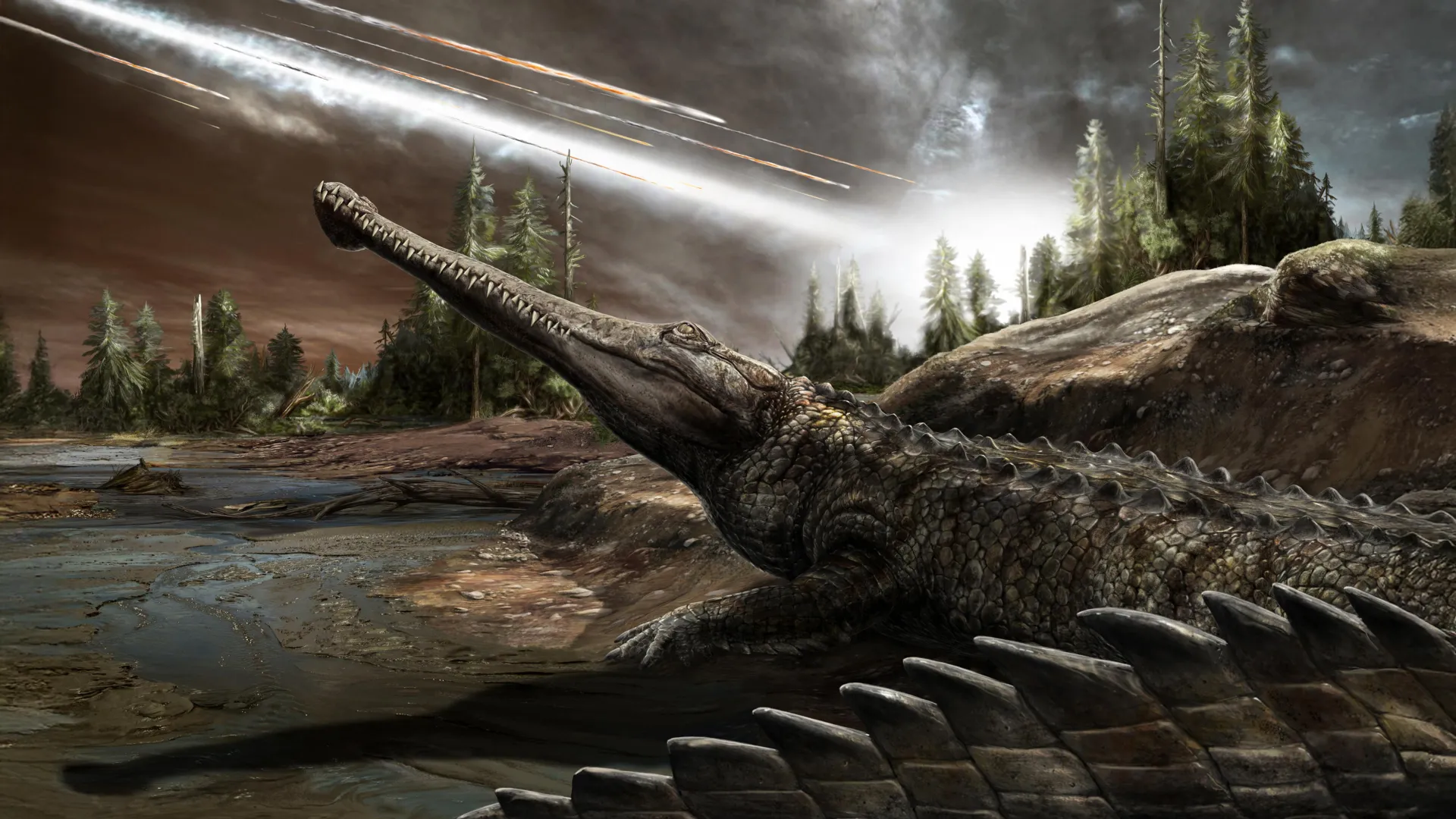
The asteroid killed the dinosaurs. Why did crocodiles survive?

image

Why did crocodiles survive the asteroid impact that wiped out the dinosaurs 66 million years ago? New research suggests that their preference for warm environments may have given them a crucial advantage during one of Earth’s greatest mass extinctions.

Scientists led by UCL (University College London) found that crocodiles and their ancient relatives spent much of their 250 million years of evolutionary history following warm climates rather than adapting to dramatically different temperatures. When Earth grew hotter, they expanded into new regions, sometimes reaching as far as Antarctica. As temperatures fell, they moved back toward the tropics.

Published in Science Advances, the study analyzed more than 7,000 fossils and records from over 400 living and extinct species. Researchers combined this evidence with computer models that reconstructed Earth’s climate and geography across 245 million years.

The results suggest that tropical and subtropical regions remained suitable for crocodile relatives after the asteroid struck, even as the environments available to many dinosaurs deteriorated. Only the most extreme climate simulations eliminated these potential refuges.

Why Crocodiles Survived the Dinosaur Extinction

The researchers examined how conditions on Earth may have changed following the asteroid impact 66 million years ago. Their simulations indicated that areas near the equator could have remained warm enough to support crocodile relatives, providing places where surviving populations could persist and eventually recover.

Previous modeling by members of the same research team found that suitable habitats for non-avian dinosaurs (i.e., the ones that went extinct) contracted much more severely after the impact.

Lead author Dr. Alfio Alessandro Chiarenza, based at UCL Earth Sciences, said: “The asteroid did not make the whole planet equally hostile to every group.

“Crocodiles’ long-standing preference for warm environments may have placed survivors exactly where suitable climates held up best, like around the equator. These refuges could have sheltered populations that later recovered and radiated out.”

The discovery offers a possible explanation for how a group of animals that appeared around the same time as dinosaurs managed to endure two of Earth’s five major mass extinctions.

Ancient Crocodiles Were Far More Diverse

Modern crocodiles and their close relatives share many recognizable features, but their evolutionary history reveals a much wider variety of body shapes, sizes, and lifestyles.

The broader crocodile lineage, known as pseudosuchians, once included heavily armored plant eaters, predators that hunted entirely on land, and enormous animals weighing more than a metric ton.

Among the most remarkable was Sarcosuchus, a giant predator nicknamed the “super croc” that could reach 12 meters in length. Another prehistoric relative, Postosuchus, was a land dwelling hunter capable of moving on either two legs or all four.

Dr. Chiarenza said: “Crocodiles are often called living fossils, but their ancestors and relatives changed enormously throughout their history, ranging from giants the size of a bus that could have devoured a T. rex, to small, cute animals with the face of a pug.

“Our study shows that, despite all this diversity, what stayed surprisingly consistent was their relationship with climate.”

Fossils Reveal 245 Million Years of Climate History

To investigate that relationship, the scientists reconstructed the temperature and rainfall preferences of 400 crocodile species and their ancient relatives. They used fossil evidence, evolutionary family trees, and detailed maps of where living crocodile species are found today.

The team then compared these preferences with reconstructions of ancient geography and climate to identify where suitable habitats existed at different points in Earth’s history.

A clear pattern emerged. Crocodile relatives generally followed warmer conditions as the planet’s climate changed, expanding their ranges during hot periods and retreating when temperatures cooled.

About 50 million years ago, during the particularly warm early Eocene, global temperatures were approximately 10°C higher than today, and the polar regions had no permanent ice. Crocodile relatives lived at high latitudes across North America, Europe, and even Antarctica.

Over the following millions of years, global cooling gradually reduced the areas where they could thrive. Their geographic range contracted toward warmer tropical regions.

Two Surprising Exceptions

Although this preference for warm environments remained remarkably consistent, the researchers identified two important exceptions.

During the Cretaceous Thermal Maximum, approximately 94 million years ago, global temperatures climbed as much as 14°C above modern levels. One branch of the crocodile family tree evolved the ability to tolerate hotter conditions than the broader lineage could withstand at other times.

A separate adaptation occurred around 34 million years ago in Australia. As a prolonged cooling period reduced rainfall and dried out the continent, an extinct group of crocodiles adapted to increasingly arid, desert-like environments.

These exceptions show that some crocodile relatives could evolve to handle different climates, even though most continued to follow their preferred warm conditions.

What Happened After the Dinosaur-Killing Asteroid?

The researchers also used climate simulations to investigate the decades and centuries immediately following the Chicxulub asteroid impact, which triggered the extinction of most dinosaurs.

They explored several possible environmental consequences, including sunlight being blocked by dust and ash and rising carbon dioxide levels associated with volcanic eruptions.

When the simulations reduced sunlight by 5% or 10%, warm regions near the equator remained suitable for crocodile relatives. These areas could have provided critical refuges during the environmental disruption.

However, a more severe scenario involving a 15% reduction in sunlight left those regions unsuitable as well. The researchers noted that this extreme level of reduced sunlight is now considered unlikely.

Other simulated changes, including increased atmospheric carbon dioxide, did not alter the availability of suitable climates for crocodiles.

Together, the results suggest that crocodiles may have benefited from living in regions where temperatures remained within their preferred range, even as conditions became much less favorable for many dinosaurs.

The Survival Strategy That Could Now Become a Weakness

The researchers emphasized that favorable temperatures were probably only one reason crocodiles survived the mass extinction.

Other characteristics likely improved their chances, including relatively small body sizes, the ability to live partly in water, flexible diets, and modest energy requirements. As ectothermic (“cold-blooded”) animals, crocodiles need less food to maintain their bodies than many animals that generate their own body heat.

The findings also raise important questions about how crocodiles will respond to modern climate change.

For millions of years, moving into regions with suitable temperatures appears to have been one of their main responses to a changing planet. Today, however, expanding cities, agricultural land, and roads increasingly limit where wildlife can move.

Professor Philip Mannion, based at UCL Earth Sciences, said: “These findings have implications for species today. If crocodiles mostly coped with past climate change by moving towards suitable habitats, today’s species will need room to move as the planet warms, and the loss of suitable areas to roads, farms and cities is making that harder.”

The research was funded by The Royal Society, the Leverhulme Trust, and the National Environment Research Council (NERC).

Don’t miss these tips!

We don’t spam! Read more in our privacy policy

LEAVE A REPLY

Please enter your comment!
Please enter your name here

Hot this week

What are the animals in your home learning from each other?

LEARNING FROM EACH OTHER Leaf, Sunshine, and Cuddles The animals who...

A tiny squeeze dramatically changes the magnetism of exotic materials

Scientists at the Department of Energy's Oak Ridge National...

AI Is Thriving at Capital One

If one were making a list of the companies...

25+ Must-Haves for Any SPED Teacher

Being a special education teacher is tough, but so...

The Biggest Snowman Ever Activities for Special Education

This post contains Amazon affiliate links. As an Amazon...

Topics

What are the animals in your home learning from each other?

LEARNING FROM EACH OTHER Leaf, Sunshine, and Cuddles The animals who...

AI Is Thriving at Capital One

If one were making a list of the companies...

A tiny squeeze dramatically changes the magnetism of exotic materials

Scientists at the Department of Energy's Oak Ridge National...

‘Caligula’ Director Tinto Brass Dies at 93

The Italian filmmaker was best known for his hardcore...

17 better ways Elon Musk could have wasted $446 million

He’s not even good at being rich!He’s not even...

European summer ‘deadliest’ for heatwaves

This summer was Europe’s deadliest on record, with more...

Related Articles

Popular Categories

News Feed

Nepal seeks stronger recognition of mountain issues in UN climate process

In the wake of its recent glacial flooding disaster, Nepal and the kingdom of Bhutan have proposed a new agenda item on mountains and...

At an old steel site in Pittsburgh, bacteria evolved to survive – and eat – industrial pollution

by Catherine Armbruster, Carnegie Mellon University Across Appalachia and the Rust Belt region, including throughout the city of Pittsburgh, former industrial sites are being transformed...

Will even one of the U.N.’s 17 ‘sustainable development goals’ be met by 2030?

Read the full story from NPR. By any standards, it was an eye-popping to-do list. No poverty. Zero hunger. Quality education for all. Gender equality. Clean...

As climate disasters multiply, Indigenous governance offers a way forward

Read the full story at Grist. Indigenous communities are confronting mounting climate threats even as inadequate funding, scant legal recognition, and little support for self-governance...

Rapidly diverging public trust in science in the United States

Milkoreit, M., & Smith, E. K. (2025). Rapidly diverging public trust in science in the United States. Public Understanding of Science, 34(5), 616–627. https://doi.org/10.1177/09636625241302970...

That fresh cleaning smell could be filling your home with nanoparticles

Read the full story from the American Chemical Society. Researchers found that scented cleaners can react with ozone indoors to create billions or trillions of...

The world has a new plan to save nature, but it still needs the money

Read the full story at Ars Technica. The world is set to miss its 2030 conservation goals as finance and action have fallen short, leaders...

Want your photos to survive for decades? A digital archivist explains what to do

Read the full story at PC World. Ina-Maria Jansson is a researcher and archivist at Uppsala University Library and works on the preservation of personal...

The locations of North Carolina’s industrial poultry farms have been a secret—until now

Read the full story at Inside Climate News. …three environmental nonprofits, CleanAIRE Carolina, Rural Empowerment Association for Community Help and the N.C. Environmental Justice Network,...

18 adorable winners from the Dog Photography Awards

Read the full story and see the photos at PetaPixel. The winners of the Dog Photography Awards 2026 have been announced, a contest that seeks...

Alabama’s new data center rules still leave customers in the dark, critics say

Read the full story at Inside Climate News. Nearly all observers agree that Alabama’s new data center policies released this week are an improvement over...

Investors are ignoring the biggest source of data-center water use

Read the full story at Trellis. Most of a data center’s water is consumed at the power plant that supplies it, but financiers screen mainly...

5 more ways to repurpose an old Kindle

Read the full story at How To Geek. There are plenty of things you can do with an old Kindle, from loading it with children’s...

Where opposition to data centers and renewable energy projects converge

Read the full story at Inside Climate News. Some of the arguments against data centers sound familiar. Opponents say the projects will change the look and...

A 2,500-year-old ski? The melting alps release ancient secrets.

Read the full story in the New York Times (gift article). The Alps are losing ice faster than almost anywhere on the planet. And, as...

The humble tree hole turns out to be a remarkable climate refuge

Read the full story at Anthropocene Magazine. Just as humans head indoors for warmth in the winter and shade in the summer, tree-dwelling animals use...

Big tech lost the election. Now comes the gaslighting.

Read the full story at The Lever. As Democrats prepare to investigate Silicon Valley, its liberal-branded lobby is scrambling to erase voters’ resounding rejection of...

Meet the Leader: Lynsey Scott of Kiche

Read the full interview at Meet the Leader. See also kitchen hacks for reducing food waste on the Kiche website. The co-founder and co-CEO of...

Popular articles

Nepal seeks stronger recognition of mountain issues in UN climate process

In the wake of its recent glacial flooding disaster, Nepal and the kingdom of Bhutan have proposed a new agenda item on mountains and...

At an old steel site in Pittsburgh, bacteria evolved to survive – and eat – industrial pollution

by Catherine Armbruster, Carnegie Mellon University Across Appalachia and the Rust Belt region, including throughout the city of Pittsburgh, former industrial sites are being transformed...

Will even one of the U.N.’s 17 ‘sustainable development goals’ be met by 2030?

Read the full story from NPR. By any standards, it was an eye-popping to-do list. No poverty. Zero hunger. Quality education for all. Gender equality. Clean...

As climate disasters multiply, Indigenous governance offers a way forward

Read the full story at Grist. Indigenous communities are confronting mounting climate threats even as inadequate funding, scant legal recognition, and little support for self-governance...

Rapidly diverging public trust in science in the United States

Milkoreit, M., & Smith, E. K. (2025). Rapidly diverging public trust in science in the United States. Public Understanding of Science, 34(5), 616–627. https://doi.org/10.1177/09636625241302970...

That fresh cleaning smell could be filling your home with nanoparticles

Read the full story from the American Chemical Society. Researchers found that scented cleaners can react with ozone indoors to create billions or trillions of...

The world has a new plan to save nature, but it still needs the money

Read the full story at Ars Technica. The world is set to miss its 2030 conservation goals as finance and action have fallen short, leaders...

Want your photos to survive for decades? A digital archivist explains what to do

Read the full story at PC World. Ina-Maria Jansson is a researcher and archivist at Uppsala University Library and works on the preservation of personal...

The locations of North Carolina’s industrial poultry farms have been a secret—until now

Read the full story at Inside Climate News. …three environmental nonprofits, CleanAIRE Carolina, Rural Empowerment Association for Community Help and the N.C. Environmental Justice Network,...

18 adorable winners from the Dog Photography Awards

Read the full story and see the photos at PetaPixel. The winners of the Dog Photography Awards 2026 have been announced, a contest that seeks...

Alabama’s new data center rules still leave customers in the dark, critics say

Read the full story at Inside Climate News. Nearly all observers agree that Alabama’s new data center policies released this week are an improvement over...

Investors are ignoring the biggest source of data-center water use

Read the full story at Trellis. Most of a data center’s water is consumed at the power plant that supplies it, but financiers screen mainly...

5 more ways to repurpose an old Kindle

Read the full story at How To Geek. There are plenty of things you can do with an old Kindle, from loading it with children’s...

Where opposition to data centers and renewable energy projects converge

Read the full story at Inside Climate News. Some of the arguments against data centers sound familiar. Opponents say the projects will change the look and...

A 2,500-year-old ski? The melting alps release ancient secrets.

Read the full story in the New York Times (gift article). The Alps are losing ice faster than almost anywhere on the planet. And, as...

The humble tree hole turns out to be a remarkable climate refuge

Read the full story at Anthropocene Magazine. Just as humans head indoors for warmth in the winter and shade in the summer, tree-dwelling animals use...

Big tech lost the election. Now comes the gaslighting.

Read the full story at The Lever. As Democrats prepare to investigate Silicon Valley, its liberal-branded lobby is scrambling to erase voters’ resounding rejection of...

Meet the Leader: Lynsey Scott of Kiche

Read the full interview at Meet the Leader. See also kitchen hacks for reducing food waste on the Kiche website. The co-founder and co-CEO of...