

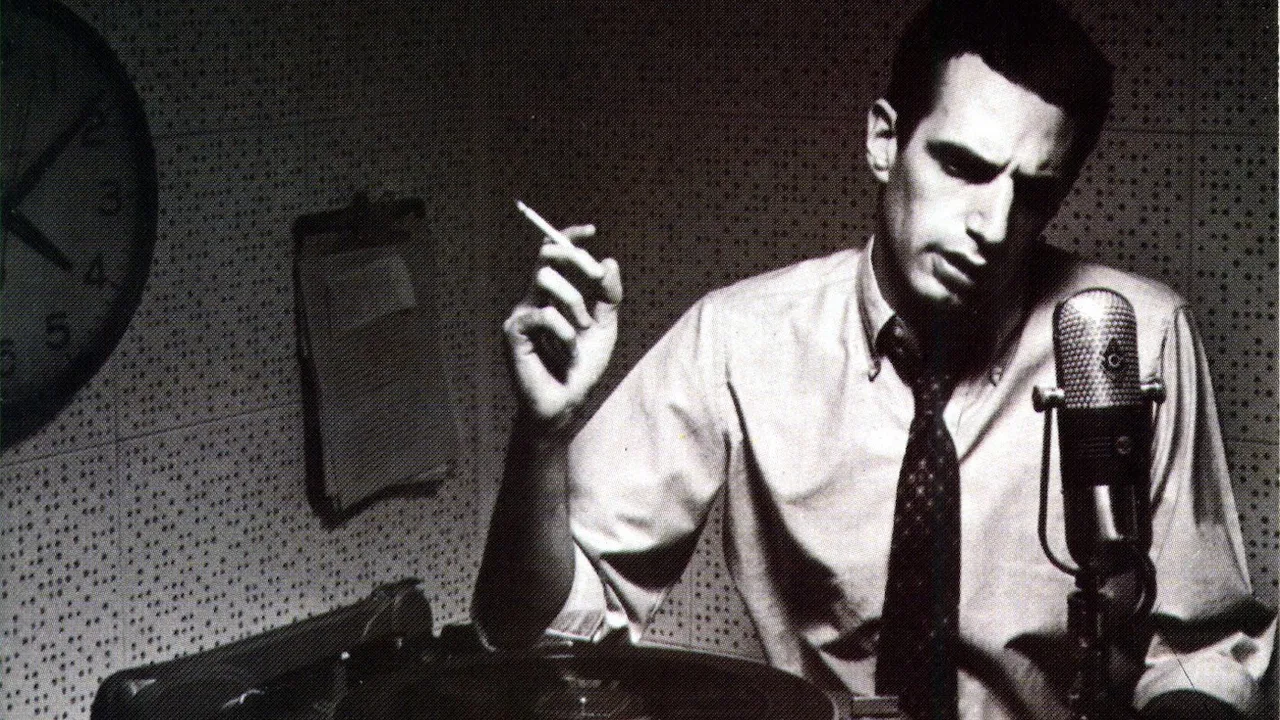
In Steely Dan’s “Hey Nineteen,” Donald Fagen sings from the perspective of a dude who’s losing his dignity. He’s in his early 30s, and since he’s been living hard, he feels 10 years older. We know his girlfriend’s age from the title and chorus, and he’s feeling like a putz because they come from different worlds, have nothing in common, and yet they’re together because when nothing makes sense you may as well fall back on lust. The closing lines about Cuervo Gold and the fine Colombian are the song’s most famous, for good reason. The song’s second-most famous lines are probably, “Hey nineteen/That’s ’Retha Franklin/She don’t remember/The Queen of Soul.” It’s not that he expected his date to be familiar with Aretha, the LP the Queen of Soul released in 1980—it has a fantastic version of “What a Fool Believes,” by the way—but rather that her lack of music knowledge shows just how badly he’s sold out to his baser impulses. Fagen was and always had been a snob, and he was proud of it. His character was so pathetic, he couldn’t even hold on to that.
During the recording of Gaucho, the 1980 album whose lead single was “Hey Nineteen,” Steely Dan fell apart. Fagen’s longtime musical partner, Walter Becker, was recovering after being struck by a cab in New York, a process complicated by his drug addiction. Becker was in deep water following the recent death of his girlfriend, who overdosed in his apartment, a tragedy that would bring a wrongful death lawsuit from her family. Considering Becker’s hobbled state, physically, emotionally, and legally, Fagen assumed an additional creative burden to complete the album. By the time it was finished, the frontman was fried and ready to try something else. “Basically, we decided after writing and playing together for 14 years, we could use a changement d’air as the French say,” he told The New York Times in June 1981, explaining the studio hiatus that would ultimately last almost 20 years.
No score yet, be the first to add.
From the band’s inception, Steely Dan’s songs had been written from the perspective of a persona that combined elements of Fagen’s and Becker’s sensibilities. This allowed the singer a certain amount of detachment and gave him license to write about broken people and fucked-up situations with biting humor and ice-cold irony (though he didn’t sing lead, Becker made important contributions to the band’s lyrics all along). After Gaucho, Fagen began to wonder what it would feel like to write from his own point of view. “I actually tried to write these new songs with as little irony as possible… I wanted this album to be a little brighter and a little lighter than a Steely Dan record; I wanted it to be more fun to listen to,” he told the Times in a 1982 interview. As Becker split for Hawaii, Fagen started to conceptualize a series of songs that would explore the period of late childhood and his early teenaged years, the time when he heard the siren call of hip and started down the path of snobbery that found its terminus when his band reached a temporary end.
Though he disliked the idea of concept albums, a form rock had been lousy with over the previous decade, Fagen’s vision for a collection of songs set in a particular time and place with overlapping themes fit the description. He began writing about the sensations and experiences of a boy coming of age between approximately 1958 and 1963, which for him meant between the ages of 10 and 15. Much of this world reached him through the airwaves, specifically the stations that served the greater New York City area. Though he was less than 50 miles from the city, he was a lonely nerd consigned to a distant outpost, especially when his family relocated to a new housing development in South Brunswick Township. To him, the straight life was a prison—“I’d been framed and sentenced to a long stretch at hard labor in Squaresville,” is how he put it in his 2013 memoir, Eminent Hipsters—and radio gave him the information needed to plot his escape.
He came up with a character called the Nightfly, a composite of witching-hour jocks who had expanded his music knowledge and sharpened his inherent skepticism about the American way. In his memoir, Fagen identified Mort Fega of WEVD and his late-night show, Jazz Unlimited, as a fount of inspiration. Jean Shepherd, now best known as the writer and narrative voice of the movie A Christmas Story, was another of the boy’s gods, as he delivered lengthy monologues about defying convention and distrusting the crowd, hinting at the freedom of a bohemian life Fagen would eventually pursue with abandon.
Though he thought of his first outing on his own as a break from Steely Dan, with personal songs that never would have made sense in the context of the band, the recording picked up exactly where the group had left off. He enlisted the crew that had enabled him and Becker to go off the deep end in a quest for sonic nirvana—producer Gary Katz, engineer Roger Nichols, and Elliot Scheiner, who tracked and mixed. These studio geniuses, when combined with first-call session musicians familiar from Steely Dan credits—guitarists Larry Carlton and Hugh McCracken, drummers Jeff Porcaro and Ed Greene, bassists Chuck Rainey and Anthony Jackson, the Brothers Brecker on horns, among others—suggested the continuity between the band and the solo career would be seamless. The tech they deployed ensured that it would be.
The first order of business was to assess the state of the art of record-making in 1981 to better understand the tools they’d be working with. Nichols ran tests comparing sounds laid down on 24-track analog tape with those captured by a new 32-track digital unit manufactured by 3M, and found the latter superior. The sample-based rhythm device known as “Wendel” that Nichols invented for Gaucho, which allowed individual drum and cymbal sounds to be captured from a live kit and arranged on a grid more precise than one a mere human like Porcaro could manage, had been upgraded to the 16-bit Wendel II, and it could plug directly into the 3M system. With the level of skill and talent in the room and Fagen’s neurotic focus, The Nightfly would be a glimmering sonic masterpiece, even as his material looked back to the days of two-track recordings mixed to mono.
Technology promises salvation, and it often lies. The opening “I.G.Y. (International Geophysical Year)” takes its title from a global initiative that brought scientists from 67 nations together to expand the collective store of knowledge and usher humanity into the future. Fagen was drawn to this period in part because it seemed like history was repeating itself in the early ’80s. The Cold War was on, the apocalypse could theoretically come down at any moment, but science was the path out of darkness—the powers that be said technology was going to straighten everything out, as he later put it in an interview with Musician. In his songs, he remembered the optimism of the time, some of which he may have even allowed himself to indulge in, while simultaneously pointing out the cracks in the system.
That the construction of “I.G.Y.” is so exquisite, with every individual sound laid in place like a jewel, makes his lyrics about the lost future hit that much harder. Lines like “A just machine to make big decisions/Programmed by fellows with compassion and vision” land differently in the time of the large language model, and the arrangement puts it over the top. The horns. The synth squelch. The layered voices, some of which are Fagen’s own, and some of which belong to Valerie Simpson, who had previously animated several Steely Dan classics. Porcaro is credited with “additional drums” because he added the fills, while James Gadson’s playing, calibrated and fine-tuned by the Wendel II, gives it its pulse. “I.G.Y.” hit the Top 40, and 90 percent of the people who heard it leaking out of a radio probably thought it was a new Steely Dan track.
The record’s second single, “New Frontier,” is built around a fantasy common to the Cold War era: kids throwing a party and hooking up in the backyard bomb shelter. (A similar situation was the setting for an extended sequence and song in Grease 2, also from ’82.) “New Frontier” even got a music video, which essentially renders the lyrics as a script. A beat snapped tightly to the grid hints at reggae, a harmonica wails away and then vanishes, Carlton’s guitar haunts the boy-meets-girl story like an invisible third character, and a dead-simple four-note piano motif is a profound declaration of uncertainty, a counter to Fagen’s bemused lyrics. His riffs on pianist Dave Brubeck (“He’s an artist, a pioneer”) and his teenaged dreams (“Well I can’t wait till I move to the city/Till I finally make up my mind/To learn design and study overseas”) capture the charming and often deluded bearing of youth, when you are sure you have life figured out and can’t wait to share what you know with the world.
The title track is written from the perspective of the DJ Fagen envisioned, the sage who schooled his younger self on what mattered, though this character is more of a Shepherd type. He advertises “jazz and conversation,” and the chorus hook spells out the call letters “WJAZ” in perfect emulation of station IDs in the period, but he’s more interested in the “conversation” part. A community forms around the voice, as he takes calls from conspiracy nuts (“So you say there’s a race/Of men in the trees,” he asks one caller), throws in plugs for products, and eventually, as the night wears on, confesses that he’s still pining for a lost love.
In the middle of the set, both the so-so cover of Jerry Leiber and Mike Stoller’s “Ruby Baby”—Fagen loved the 1956 version by the Drifters—and the following piano ballad “Maxine” explicitly draw on the forms popular in his youth. On the latter, he’s essentially writing a late-’50s torch song, one you could imagine Chet Baker covering, but the production has a high-shine polish and machinelike precision impossible in an earlier era. Both “The Goodbye Look” and the closing “Walk Between Raindrops” are set in balmy locales far from the Northeast, a New Jersey vision of heaven, perhaps. In “The Goodbye Look,” our character’s dream of an easy life by the seaside is shattered by local government unrest, maybe even a coup. “Won’t you pour me a Cuban breeze, Gretchen,” he sings, before plotting an escape. And on the final track, a jaunty soul-jazz number with a Caribbean tinge, he fully indulges himself as an instrumentalist, soloing on organ like he’s Jimmy Smith.
The specific references to the music of the ’50s and ’60s that Fagen so dearly loves highlight a central tension in his work. While he was a devotee of blues and R&B and studied carefully to become a jazz elitist, what he loved about these records—the spontaneity, group interplay, and improvisation—is something he rarely pursued in his own work, especially as time went on. He’s often mentioned that the R&B-derived rock’n’roll he loved so much in the ’50s lost some juice at the start of the new decade. When I read that, my mind goes to the singles Phil Spector was making during that stretch: The players were anonymous, the producer was king, and the sound was a fuzzy blur of unhinged emotion, where it was hard to know where one part left off and another began.
Fagen’s studio approach is the opposite. The musicians he worshipped when young were virtuosos, but it was the way they played together in a real-time environment that made it swing. And while he sometimes felt as if he should make records based around people in a room performing together, the lure of perfection was too strong. Before long, he was listening over and over to the difference between two hi-hat taps to see which was more likely to cut through the mix. The studio fussiness is why Fagen’s music would later go in and out of style—when raw sounds are in fashion, people tend to point out where his band’s singles landed on the Easy Listening charts.
The new collection landed in shops in early October 1982 and was received well by peers of Fagen’s generation who knew exactly where he was coming from. In every era since at least the ’60s, it’s been common for people who enter their 30s to comb through the totems of their youth in an attempt to understand where they came from and where they might be heading. In the ’80s, the size of the Baby Boomer generation meant that this process of reckoning was a steady presence in the media. A year after The Nightfly, Lawrence Kasdan’s The Big Chill became a phenomenon, with an accompanying soundtrack that went 6x platinum. One of its 10 tracks was “(You Make Me Feel Like) A Natural Woman” by Aretha Franklin. Her once-fizzling career was already on the upswing, and in another couple of years, she’d be on MTV and would never slip out of the conversation again.
The hit film in theaters when Fagen was promoting The Nightfly was Steven Spielberg’s E.T. the Extra-Terrestrial. He did an unusual amount of press for the new release, and he often brought up the connection between his suburban upbringing and that depicted in the film. “Thelonious Monk was the alien in my bedroom,” he said to Musician in early 1983, repeating the remark with slight variations in several other pieces. After he finished the record, Fagen began having panic attacks for the first time in years—in his memoir, he said that he “came apart like a cheap suit.” He powered through the chaotic ending of Steely Dan and made a brilliant album, and now he needed to step away for what turned out to be a full decade. We didn’t hear from him, but the music he’d made to that point wasn’t going anywhere.