

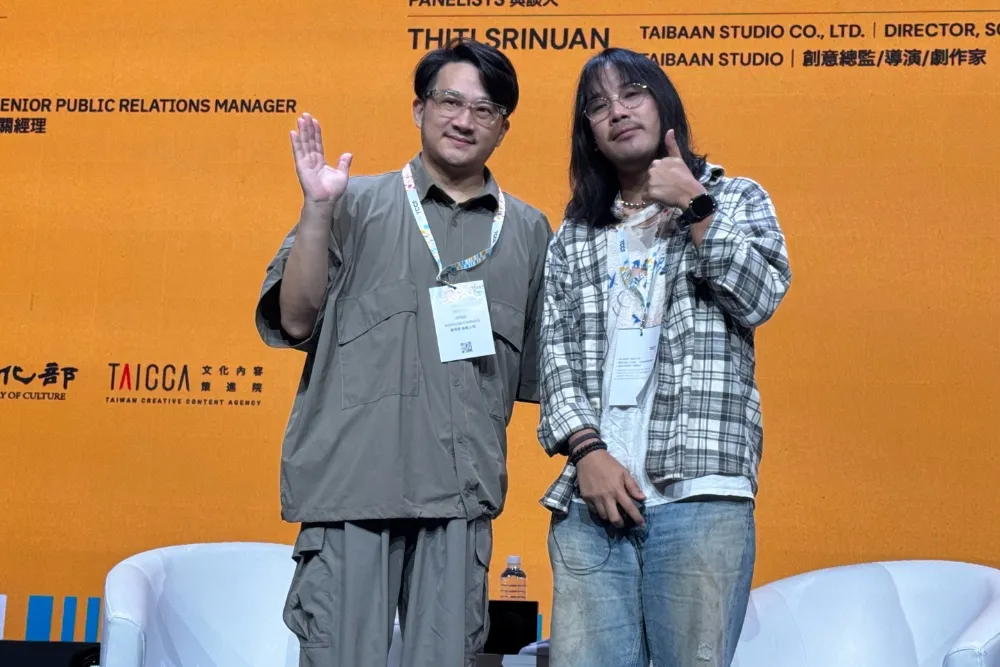
Thiti “Tongte” Srinuan, director of Thai blockbuster “The Undertaker,” put up a photo of himself defecating on camera for real during a session at Taiwan Creative Content Fest in Taipei. The scene dates from his days as a supporting actor with Taibaan Studio.
“I was a supporting actor, and I played a crazy person,” Srinuan said. “Because he’s crazy, he relieves himself wherever he likes.” Rather than use a prop, the production had him actually do it on set.
“Forty or 50 people were sitting there watching me, and I felt like I couldn’t go,” he said.
The session was moderated by Mr. Knee, senior public relations manager at Vieshow Cinemas and the Taiwan Film Critics Society’s founding chair. Knee noted that the photo was a surprise to organizers too, who had only seen it that morning.
Srinuan said the episode showed him how far the studio went for realism, and that realism is what makes its universe flexible. Because every character feels like a real resident of the same village, any of them can be pulled out to lead a film, whether the studio wants a ghost story or a romance.
Srinuan, who wrote and directed “The Undertaker” and its sequel for Taibaan Studio, was the sole panelist at the TCCF forum on how user-generated content is turning into a route to theatrical features. Much of his talk was about money. Before “The Undertaker” grossed more than THB700 million ($20.8 million) in Thailand, much of the Taibaan universe was bankrolled with revenue from online music videos.
The 2023 film, the sixth feature in the Taibaan universe, became the highest-grossing Thai film in nine years. The franchise is rooted in the language and culture of Thailand’s northeastern Isan region. Its sequel arrived this year.
Srinuan came into the business as an extra and supporting player in Taibaan Studio’s films. The crew was a small group from rural Thailand with little formal training, so he volunteered to write scripts and then to assist on directing, working on five films in those roles. Those films played almost entirely to Isan audiences, he said. A music video he made that went viral across the country convinced him a film from the region could cross over, and when no one else would take on his script, he directed it himself.
Budgets have stayed lean. The first Taibaan film raised THB2 million ($59,000), or THB4 million ($119,000) including marketing, and grossed THB35 million ($1 million), in a market where a typical Thai feature costs THB30 million ($891,000) or more. “The Undertaker” was budgeted at THB10 million ($297,000), though Srinuan said only THB8 million ($238,000) was spent. The other THB2 million was there to make it a round number.
Raising money for a follow-up proved harder. “If we were still nobodies with no name, they couldn’t invest in us,” Srinuan said.
The team turned to building a following online instead. “Believe it or not, after the first film, the second, third and fourth films were funded by what we built online,” he said. “We earned money from music videos. The views kept running and running until we could take that money and make films.”
Because a Thai film can take a year to come together, Srinuan said he took on music videos to fill the months between shoots. His videos have now passed 4 billion views combined. Rather than accept flat fees, he asked clients for a share of the view revenue, which meant a video that flopped earned him nothing and pushed him to learn marketing. He has carried the same terms into features, asking to be paid from ticket sales instead of a fixed fee.
Music videos also shaped how he writes. He builds features out of segments of four to five minutes, the length of a music video, and lays them end to end until they reach two hours, an approach he said suits audiences raised on short-form and vertical content.
“The downside is people comment that the film swings and the emotions don’t connect. You’re laughing, then you’re made to cry, then you’re laughing again,” he said. “But to me, life is like that. You laugh sometimes, you cry sometimes. So I like it this way.”
Comments matter more to the studio than likes or shares, Srinuan said. A trailer is expected to reach roughly 20,000 shares and 2 million views with no paid advertising, and when viewers fixate on an unexpected character in the comments, the marketing shifts toward that character.
After the first Taibaan film, Srinuan borrowed Marvel’s habit of announcing a slate, declaring a universe before any scripts existed to push himself to keep working.
The title of “The Undertaker” came first. Srinuan said he picked the profession because he figured no one sees more ghosts, but early drafts were all ghosts and had little to do with the job. He then drew on his own childhood in the countryside, when he had no money and was paid to be ordained as a novice monk for funerals, watching undertakers at close range. The film turned from horror into drama, though it was still marketed in Thailand as a ghost film because that genre sells.
When the first film played in Taiwan two to three years ago, it did not catch on. “I’d like to ask the market now: does Taiwan still want blood-splattered Thai films?” Srinuan said. He suggested Taiwanese viewers had expected gory, frightening Thai horror, while his ghosts are played for laughs.
The moderator, who described the film as closer to a comedy, pointed to “Shutter” as the title that first won Taiwanese audiences over to Thai horror.
Isan is Thailand’s most populous region, but its local beliefs did not travel to the country’s other three regions, Srinuan said. For “The Undertaker,” he studied Charlie Chaplin and leaned on visual storytelling over dialogue. Traveling overseas with the first film, he found the comedy landed but the local culture often did not, and he called reaching a global audience a challenge he is still working on.
Having already handled writing, directing, acting, editing and sound, Srinuan took marketing classes after finishing the first “Undertaker.” The film opened only in Isan, playing to core fans first, and word of mouth pulled it into cinemas across the rest of the country, a strategy he likened to “the forest surrounding the city.”
The moderator cited “Backrooms” and “Milk & Serial,” both from directors who came up on YouTube, as signs of the shift. Srinuan said he saw parallels with his own path and argued that ideas count for more than budgets. “If you don’t create work, miracles won’t happen,” he said.
He said the success of “The Undertaker” has also drawn a wave of Thai YouTubers into features. “They think, ‘I have 1 million followers on YouTube. I make a film, so all 1 million people who follow me have to watch it, right?’” Srinuan said. “In reality, the first person goes in and says they didn’t like it, and the other 999,999 start deciding whether to watch or not. Then the second person goes in and says it’s not OK, and 900,000 people are gone.”