

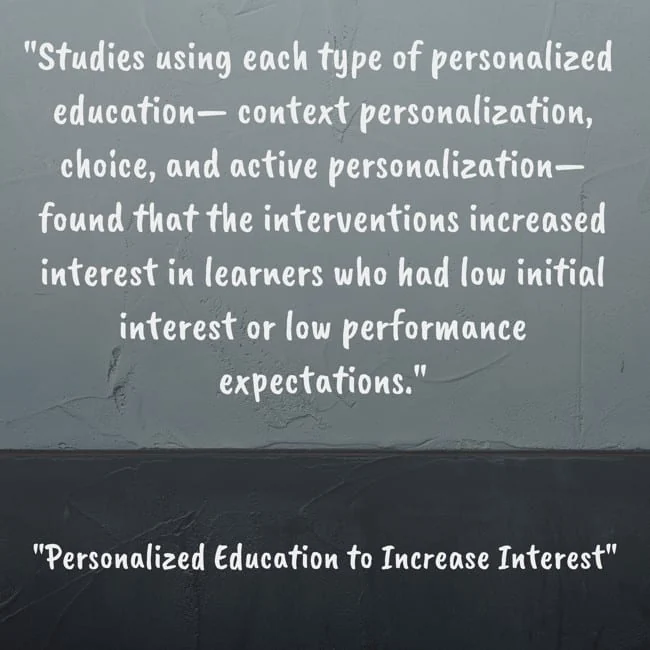
A whole lot has been written about the idea of “personalized learning” in education (see The Best Resources For Understanding “Personalized Learning”).
I recently saw two interesting tweets about it:
Interesting Open Access piece on the link below too: https://t.co/IEgAgEyott
— Terry Pearson (@TPLTD) June 15, 2026
Here’s an open access link to the first one.
I asked ChatGPT to provide a summary:
Here is the practical version I would give a classroom teacher after reading this review and the research it summarizes:
Students become more interested in learning when they can answer one of these questions:
- “How does this relate to me?”
- “Why should I care?”
- “Can I connect this to something I already know or like?”
The strongest finding is not simply that teachers should make lessons relevant. It is that students should actively make the relevance themselves whenever possible.
In other words, having students generate personal connections is often more powerful than the teacher providing them.
1. Let students connect content to their own lives
After a lesson, ask students to write for 2–3 minutes:
- How could this help you in your life?
- When might you use this information?
- How does this connect to something you already know?
- How might this matter to your family or community?
Examples:
Science:
How could understanding ecosystems help someone in your neighborhood?
History:
What issue discussed today still affects people today?
Math:
Where might someone use percentages outside school?
For ELLs:
- Sentence starters help:
- “This reminds me of…”
- “I could use this when…”
- “This is important because…”
- “In my country/community…”
Research implication: This is probably the highest-impact strategy discussed in the article.
2. Offer meaningful choices
Choice does not mean unlimited freedom.
Good examples:
Instead of:
Everyone writes the same report.
Try:
Choose one of three topics.
Or:
Show your learning through a poster, presentation, video, or essay.
Or:
Choose one article from four options.
The key is that students feel ownership.
For ELLs:
- Choice of reading topic
- Choice of partner
- Choice of response format
- Choice of examples
Small choices often work as well as large ones.
3. Personalize examples
When possible, use examples connected to students’ interests.
Examples:
Math:
- Basketball statistics
- Soccer scores
- Music streaming numbers
Science:
- Pets
- Food
- Social media algorithms
Writing:
- Topics students care about
- Community issues
- Future careers
However, the review suggests this may be less powerful than having students create the connections themselves.
Many teachers think:
“I just need to make lessons fun.”
That is not what this research emphasizes.
The key is not entertainment.
The key is helping students see:
- personal relevance
- usefulness
- connection to identity
- connection to goals
A lesson can be rigorous and still feel highly relevant.
This research fits particularly well with effective ELL instruction because ELLs bring rich experiences, languages, and cultural knowledge into the classroom.
Helpful practices include:
- Connecting content to students’ home countries.
- Encouraging comparisons between cultures.
- Having students interview family members.
- Asking students to relate topics to community experiences.
- Letting students choose examples from their own lives.
Examples:
Science:
How is water used differently in different countries?
History:
Does your family know stories similar to this one?
Math:
Where does your family use math in daily life?
Language Arts:
Does this character remind you of anyone you know?
At the end of a lesson, ask students to complete:
- Something I learned today:
- Why it matters:
- How it connects to my life:
For ELLs, you can provide frames:
- Today I learned ______.
- This matters because ______.
- This connects to my life because ______.
This takes 2–3 minutes and captures the core recommendation from the review: helping students actively personalize what they are learning.
If I had to reduce the entire article to one classroom recommendation, it would be:
Build frequent opportunities for students to explain how the content relates to their own lives, interests, experiences, or future goals. That is the personalization strategy with the strongest theoretical and empirical support.