

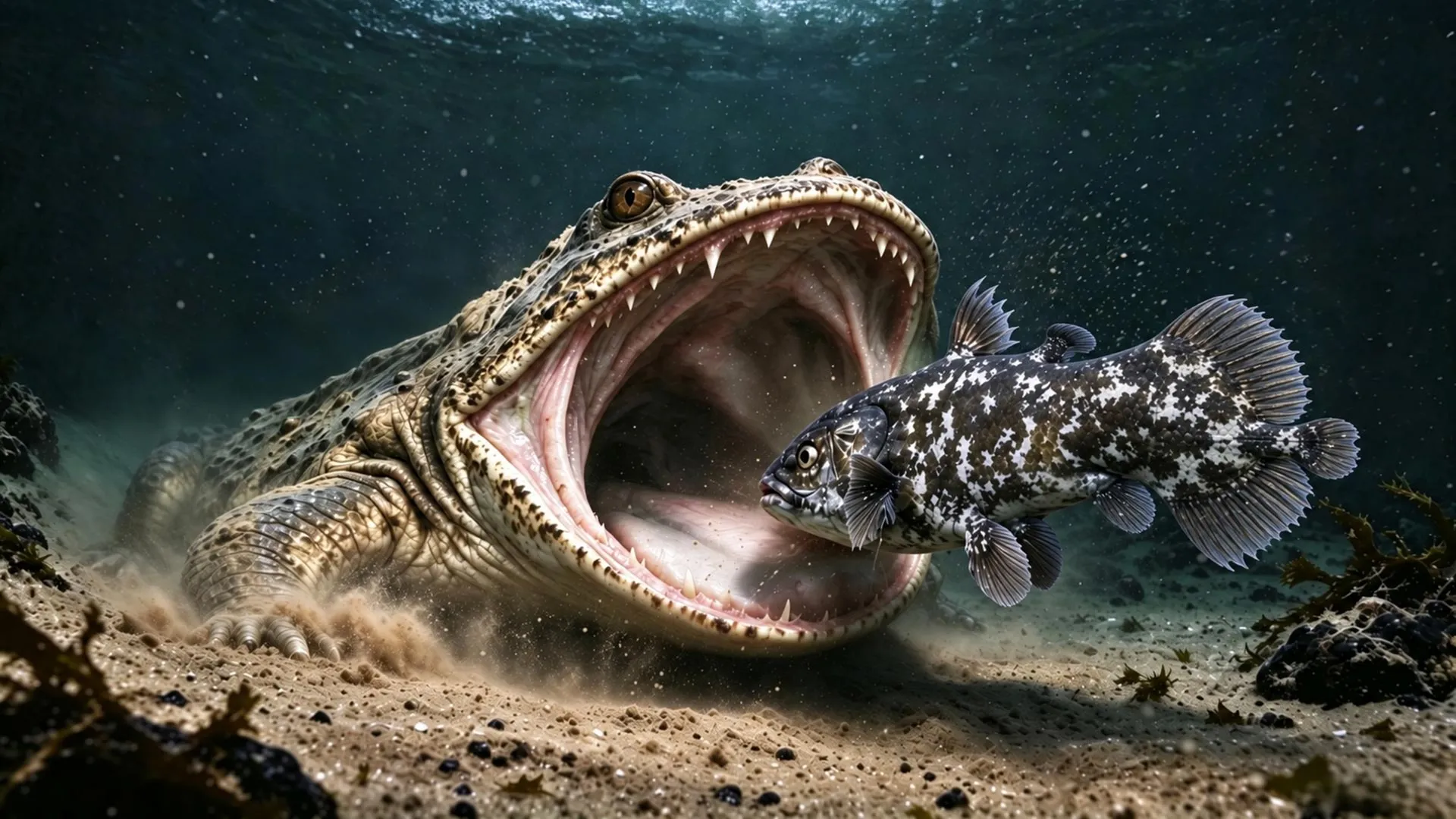
A remarkable fossil discovery in China has revealed an ancient amphibian that lived entirely in the ocean, something no amphibian alive today is known to do. The unusual animal, named Gerrothorax maritimus, had a broad, flattened body protected by bony armor and was roughly the size of a giant salamander. Researchers believe it spent much of its life on the seafloor, waiting to ambush passing prey.
The discovery comes from an international team at the University of California, Davis, Peking University, and the Geological Museum of Guizhou. Their findings, published in Nature Ecology & Evolution, are based on two exceptionally well-preserved skeletons dating back nearly 237 million years to the Late Triassic period.
Both fossils were uncovered in China’s Guizhou Province, in a region that was once submerged beneath an ancient ocean hundreds of miles from major landmasses.
“This area is part of an ecosystem that we’ve been looking at and trying to reconstruct,” said study corresponding author Ryosuke Motani, a professor in the Department of Earth and Planetary Sciences at UC Davis. “We’ve been mostly studying marine reptiles and the fish from this place, but now we also have this amphibian, and it’s a sort of very unusual member of the lineage.”
The finding is especially surprising because amphibians are generally unable to survive in seawater. Among the more than 8,000 amphibian species living today, none are known to spend their entire lives in marine environments, and fewer than 2% have any ability to tolerate salt.
Mammals, reptiles, and birds, by comparison, all include species that can live entirely at sea without relying on land for food or fresh water. Until this discovery, scientists had never identified convincing fossil evidence of an amphibian with the same ability.
A Giant Armored Amphibian Built for the Seafloor
Because the two skeletons are so complete, researchers were able to piece together the animal’s appearance and develop a clearer picture of how it lived.
Gerrothorax maritimus measured nearly three feet long, but its proportions were far different from those of a modern salamander. Rather than having a long, slender body, it was unusually broad and flattened, with a distinctive disc-shaped form.
Its body was also covered in thick bony armor, which may have helped protect it from large marine predators such as ichthyosaurs.
“If you think about today’s amphibians, this animal is unusual because it’s big,” Motani said. “It’s probably, body mass-wise, about the same as the giant salamander, but what’s different is that giant salamanders are elongated whereas this animal is really chunky.”
The structure of its skull, together with its heavy armor, suggests that this ancient amphibian was an ambush predator. Instead of actively chasing its meals, it likely rested on the seafloor until an unsuspecting animal came within reach.
“They would probably just wait at the bottom and then when prey comes around, they would just suck it in,” said Motani, who noted that the hunting strategy resembles that of the wobbegong, a type of carpet shark that lives near the seafloor and captures prey using suction.
How Could an Amphibian Survive in Salt Water?
One of the biggest mysteries surrounding Gerrothorax maritimus is how it managed to survive in an environment that is hostile to nearly all modern amphibians.
The problem comes down largely to amphibian skin. Unlike the relatively waterproof skin of many other animals, amphibian skin allows water and gases to pass through it. This makes it useful for breathing and maintaining hydration, but also leaves amphibians especially vulnerable to the effects of salt water.
“That skin is permeable, and that allows the animals to use it for multiple purposes,” said Motani. “They use it for respiration and water intake, so amphibians don’t drink or breathe through the mouth because they can do both through the skin.”
As a result, modern amphibians generally depend on freshwater habitats or environments close to them. A few species have developed limited salt tolerance, including the crab-eating frog. Even these animals can lose weight when exposed to brackish water and must eventually return to freshwater to recover.
The ancient Gerrothorax maritimus, however, may have evolved a very different solution.
Researchers suggest that its extensive bony armor restricted the movement of water through its skin. This protective covering may have reduced its dependence on absorbing water directly through the skin, allowing the animal to take in seawater through its mouth instead.
Under this proposed mechanism, water would have been absorbed through the digestive tract, while the animal’s gills could have helped eliminate excess salt. Gills are known to have been present in members of the Gerrothorax genus, giving the researchers reason to suspect that this species possessed a more fishlike approach to managing its salt balance.
Together, these adaptations may explain how an amphibian managed to occupy an ecological niche that remains inaccessible to its modern relatives.
Fossil Evidence Points to a Fully Marine Lifestyle
The researchers also examined whether Gerrothorax maritimus truly lived in the ocean or whether its remains might have been transported there after death.
Several clues strongly favor a marine lifestyle.
First, the skeletons were recovered from sediments deposited in a deep marine environment. Their remarkable completeness also provides important evidence about where the animals died.
“Carcasses at sea, unless they sink to the bottom right away, tend to dry out and lose limbs prior to sinking to the bottom,” said Motani. “But these animals had their fingers preserved, so that means they probably died near where they lived.”
The preservation of such delicate skeletal structures suggests that the bodies were not carried long distances before reaching the seafloor.
To investigate further, the team analyzed the fossils’ chemical composition, focusing on the relative abundance of different forms of strontium, known as isotopes.
The results closely matched the strontium isotope signatures expected in ocean water during the Late Triassic, providing another independent line of evidence that the animals inhabited a marine environment.
Taken together, the fossil preservation, geological setting, and chemical findings make a compelling case that Gerrothorax maritimus spent its life entirely at sea.
The discovery reveals an unexpected evolutionary path for amphibians, showing that at least one ancient species appears to have overcome the biological limitations that keep its living relatives largely confined to freshwater environments.
The research received funding from the National Natural Science Foundation of China.