

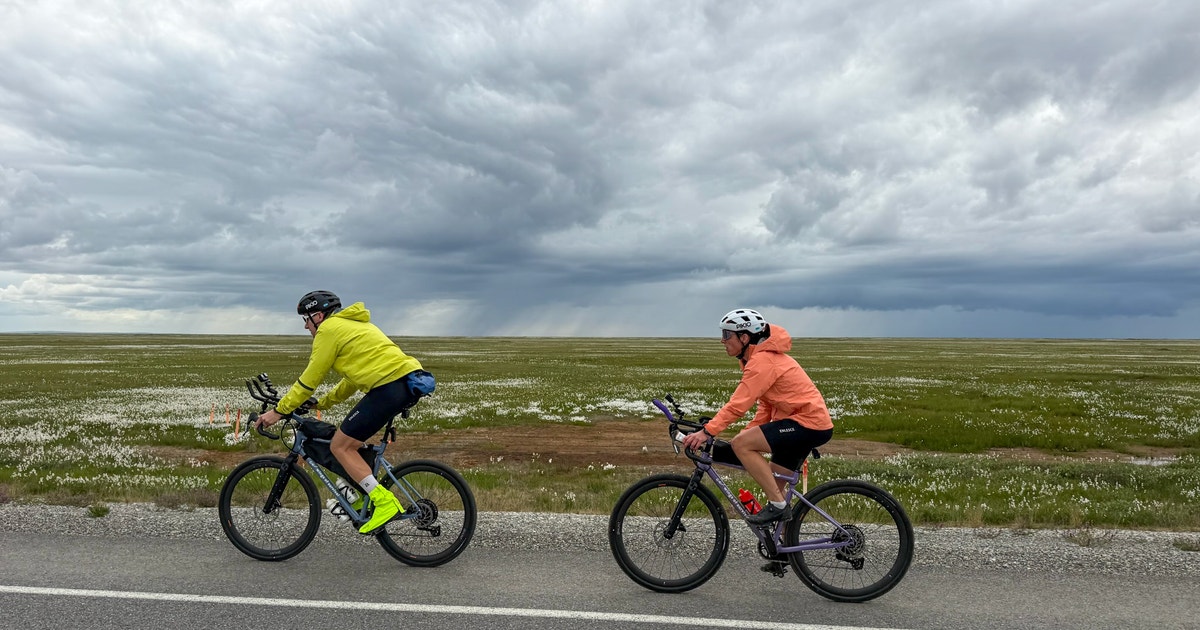
On August 1, University of Alberta ecologist Timm Döbert and his partner, extreme athlete Leanna Carriere, set off from Prudhoe Bay on Alaska’s Arctic coast, on a pair of bicycles. They had around 18,600 miles to go.
They’re now 98 days and more than 5,000 miles into a planned 9-month journey, which will loosely follow the path of one GPS-tracked Hudsonian Whimbrel as it migrates south to Patagonia. Döbert and Carriere hope that their undertaking, which they’ve dubbed Wings of Survival, will both call attention to the threatened species and help to fill some gaps in scientists’ understanding of whimbrels’ incredible journeys.
A long and dangerous migration
With long, curved bills and bodies slightly reminiscent of a football, whimbrels are unassuming endurance superstars: After spending summer on the Arctic tundra, the shorebirds wing it to coastal mudflats and beaches as far away as the southernmost tip of South America, flying in nonstop stretches of up to seven days.
Having a range that spans the Western Hemisphere also means Hudsonian Whimbrels are exposed to a complex set of threats, including development of their foraging and nesting habitats, more severe weather during migration, and rising sea levels at their stopover sites. Last year, eBird split the species from its Eurasian counterpart, and the American Ornithological Society followed suit this October. While the Hudsonian Whimbrel is not currently listed under the U. S. Endangered Species Act, this March the United Nations’ Convention on the Conservation of Migratory Species declared the species endangered, following estimates that the bird’s population has declined 70 percent in the past two decades.
In January, Döbert and Carriere traveled to Chiloé Island in southern Chile, where Juan Navedo, a Universidad Austral de Chile ecologist who has studied migratory shorebirds for 20 years, helped them place satellite tags on five Hudsonian Whimbrels. These transmitters mapped the birds’ northward migration back towards their breeding grounds, revealing individual choices along the way. While one whimbrel hopped along the coastline from Baja California to reach Alaska, for example, another flew directly over the ocean to Anchorage.
Of the five tagged birds, one is still giving data: Whimbrel 59764, which spent its breeding season near Hooper Bay in southwest Alaska. In July the bird flew back to Baja California, hopped across the Sea of Cortez to mainland Mexico, then stopped in Ecuador before continuing south. (The team can only speculate about what happened to the birds whose signals they lost. They may have died, Döbert says, or simply shed their GPS transmitters.)
While the shorebirds typically complete their 9,000-mile migration in about two months, the cyclists will have to make a much longer, slower journey. Where Whimbrel 59764 has sailed over vast stretches of open ocean, Döbert and Carriere bike down much less direct coastal highways. Wherever possible, their route will take them to locations that Hudsonian Whimbrels use as stopover sites. “There’s definitely excitement when you know you’re in a spot that the birds were,” Carriere says. “It feels very special.”
Not many Hudsonian Whimbrels have been tracked along their entire migration, due largely to the expense involved.
Not many Hudsonian Whimbrels have been tracked along their entire migration, due largely to the expense involved. Scientists don’t know exactly which places the birds rely on to complete their migration successfully—something Wings of Survival aims to help with, Navedo says. “If we solve connectivity, we can focus conservation efforts in those areas.”
Already the project is homing in on some of those crucial but previously unknown stopover sites. Earlier this year a colleague in Mexico went to a strawberry field near San Quintín, where one of the five tagged birds had turned up, and found a congregation of 500 whimbrels. That was “the largest number of whimbrels he’s seen in northwestern Mexico ever in one spot,” Döbert says. “So, we’re identifying new places that should be protected.”
The more data they collect, the better able scientists like Navedo will be to answer the many open questions about whimbrel migration, including whether the birds travel in groups or go it alone—and how they are able to complete their grueling journeys in the first place.
How whimbrels migrate such far distances
On paper, whimbrels should run out of fuel after three or four days, based on how much fat they can store and how much energy flight requires, says Chris Guglielmo, co-director of the Advanced Facility for Avian Research at Western University. But satellite tracking confirms that the birds can fly nonstop for over a week.
In the weeks leading up to migration, whimbrels build up muscle, increase the size of their exercise-related organs, and eat so much that they nearly double their body weight. After a long-haul flight, those fat reserves are gone, and their muscles and organs are depleted. “The digestive system can be half the size that it was on take-off,” Guglielmo says. “Even the heart can shrink by 25 percent.”
Though the high-resolution satellite tags required a significant investment, Guglielmo hopes it will pay long-term dividends and allow the team to use cheaper technology in the future. With a clearer understanding of where the whimbrels touch down in Mexico and Chile, for example, he can set up Motus stations and track more birds at a much lower price tag. “Motus tags are only a few hundred dollars a tag, rather than thousands,” he says.
In a typical day they’re biking 12 hours, covering about 80 to 90 miles, and consuming several thousand calories each.
Döbert and Carriere, meanwhile, are gaining a deeply personal appreciation of the birds’ migratory feats. The couple are seasoned adventurers: They rode across Canada on their bikes about two years ago, and Carriere was Canada’s first female decathlete. But this journey is much bigger than anything they’ve done before on a bicycle, Döbert says.
In a typical day they’re biking 12 hours, covering about 80 to 90 miles, and consuming several thousand calories each. Whimbrels, meanwhile, can fly more than 5,000 miles without stopping to eat, drink, or sleep, and reach speeds of up to 50 miles per hour. “It puts things in perspective for us because we’re barely hanging in there,” Carriere says. The cyclists have made themselves test subjects as well, collaborating with a colleague at the University of Alberta who is studying their resilience along the ride.
Creating community connections
Along the way, Döbert and Carriere are taking breaks from biking to visit schools, take local kids birding, and share their story with farmers, officials, and nature groups. One reason they chose the Hudsonian Whimbrel for the project, Döbert says, is because of the species’ wide distribution throughout the coastal Americas. “It allows us to visit many communities along the route, and they all have a relationship and a contact point to this particular bird.”
Each week they also connect virtually to classrooms around the world in a free livestream. The pair uses the stream, hosted by Canadian NGO Exploring by the Seat of Your Pants, to tie the challenges that migrating whimbrels may encounter to environmental issues that impact human health and well-being, including poor air quality and biodiversity loss. “I think it’s just a really exciting way for kids to connect the dots a little bit differently about human and planetary health,” Döbert said. A documentary about their journey is in the works, which they hope will highlight the places they visit and local initiatives to support human welfare and migratory birds.
Future routes could follow the Red Knot from Europe to Africa, and the Bar-tailed Godwit from Asia to New Zealand.
When Döbert and Carriere set out, they weren’t sure whether any of the birds would return to the same area where they were tagged. But according to the tracking data, Whimbrel 59764 is now back on Chiloé Island. Döbert and Carriere hope to reunite with the bird there before continuing to their ride’s end point at Ushuaia, Argentina, near the southern tip of Patagonia—and before the whimbrels fly north, beginning their astounding journey all over again.
The adventurers hope more expeditions are ahead. They have imagined Wings of Survival as a series of migration-tracing bike rides; future routes could follow the Red Knot from Europe to Africa, and the Bar-tailed Godwit from Asia to New Zealand. “But let’s see how it feels when we get to Ushuaia,” Döbert says.
For now, whimbrel decals on their bicycles provide motivation whenever they look down, Döbert says, and a reminder of how their adventure started: feeling the heartbeats of the newly tagged birds in their hands.
“You let them go, and you understand they’re going to embark now on this epic migration. There’s this bond between the birds and us,” he says. “It feels like a responsibility towards them as well to hang in there and make it happen.”