

Intimate Books About Self-Analysis and Spirituality
Autobiographical writing is often slotted into easily marketable categories—the solitary odyssey, the bereavement chronicle, the trauma plot. Meghan O’Gieblyn’s brilliantly unclassifiable “Will and Attention” resists the pull toward categorization. The memoir is in some ways a familiar story of addiction and recovery, but it has a jagged, nonlinear trajectory that makes reading it unpredictable and occasionally frightening.
O’Gieblyn, a recovering alcoholic, writes about how, after eleven years of sobriety, she suddenly and unaccountably relapsed. Around the same time, she began attending Catholic Mass, and the book hovers on the edge of becoming a conversion narrative. O’Gieblyn reads the philosophy of Simone Weil and of Iris Murdoch. She keeps working, attending conferences on the ethics of artificial intelligence, as part of her job as a journalist. She tells herself that she’ll stop drinking.
She does eventually stop, but the disorienting interval leaves her sense of self unsettled. “My life has lost its arc, and I fear that it’s become less a narrative than one of those demented children’s songs that goes around in circles,” O’Gieblyn writes. “But the desire to understand is still there; it is one more thing that I cannot manage to renounce.” I recently spoke with O’Gieblyn about her writing process and her reading habits as a memoirist.
Our conversation has been edited and condensed.
Your memoir plays with familiar categories, but it doesn’t follow a neat arc. Did you see the book as working in or resisting particular genres?
I was definitely resisting the recovery-memoir genre. In fact, I initially resisted writing about my experience with addiction altogether. I wanted to write a more traditional bibliomemoir about reading Simone Weil, but it just wasn’t working.
What helped me write more directly about my life was thinking about the book as part of a larger tradition of spiritual autobiography. In some ways, a spiritual autobiography and a recovery memoir share a similar arc: “I was lost, and now I’m found.” There’s a transformation that takes place, and an illusion that you’re standing on the other side of your struggles and speaking with authority about them.
But a lot of those traditional conversion stories are also very circular. One really beautiful example of this is Thomas Merton’s “The Seven Storey Mountain,” which is about how Merton came to be a Trappist monk. He had some powerful encounters with Catholicism, and started attending Mass while he was studying literature at Columbia. But he was also immersed in the jazz scene in New York and kept periodically returning to this life of drinking and carousing, even after his baptism. There’s a lot of circularity. The title of the memoir alludes to Dante’s Mt. Purgatorio, which is a terraced mountain climbed by going around in circles. I was interested in books that dramatize that looping path of regression and slow progress.
What other books did you draw on for inspiration?
Reading journals and diaries helped me in terms of tone and atmosphere. What I appreciate about them is that there’s an assumed reader, but it also feels like eavesdropping on somebody who is just thinking about their life.
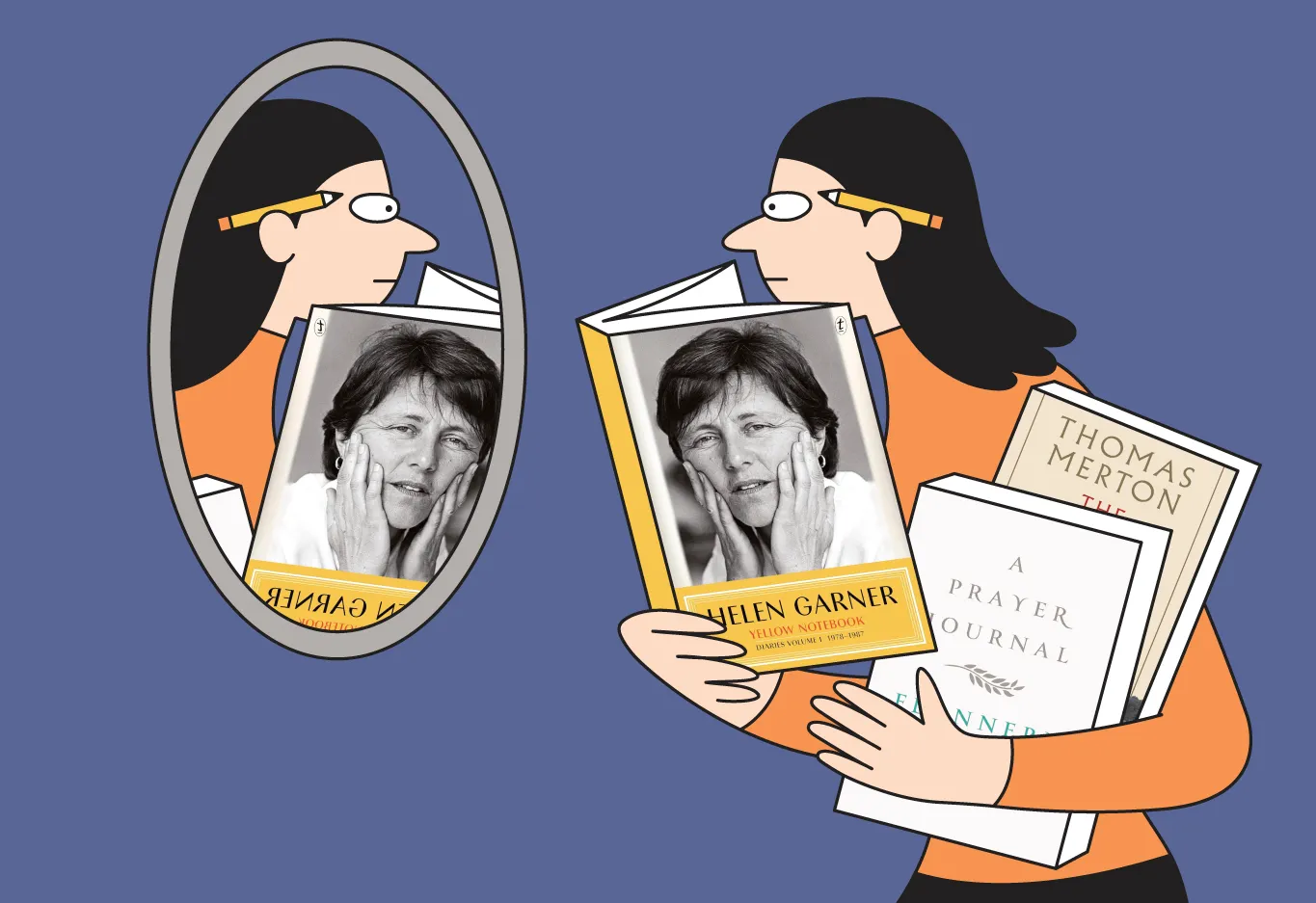
I was reading Helen Garner’s “Yellow Notebook” as I was writing, and Flannery O’Connor’s “A Prayer Journal,” in which she often wrestles with what she’s reading. I love getting to look over someone’s shoulder as they’re encountering different books and ideas, and seeing how they apply those insights to their life.
You write a lot about Simone Weil in the book, but your epigraph—“To repent of egoism: is autobiography the best method?”—is from an Iris Murdoch novel, “The Sea, the Sea.” Which is a very funny way to begin a memoir. Did you also read Murdoch’s fiction during the writing process?
I mostly read Murdoch’s philosophy, which I ended up putting in the book, but I did also read some of her novels. I like that her philosophy has such a strong moral sense, while her novels are a bit decadent and sexy.
My favorite of hers might be “The Bell.” It’s about the dangers of self-delusion, which I was thinking about a lot while writing my memoir. The characters are part of a religious community, and the book dramatizes all the ways in which their baser motives—the desire for sex or romance, for instance—can fly under the cover of spiritual aspiration. It’s a story that has serious moral stakes but is also very funny. And Murdoch uses a light hand, making the characters seem lovingly and relatably absurd throughout.
Your book also touches on technology and A.I. What would you suggest if you had to recommend reading material to our tech overlords?
I think I’d recommend Norbert Wiener’s “God & Golem, Inc.,” a 1964 book that criticizes the notion that moral responsibility can be outsourced to machines. He looks at folktales such as “The Sorcerer’s Apprentice” or “The Fisherman and the Genie,” in which the nonhuman intelligence does exactly what it’s asked but disaster ensues anyway, because the human asker failed to think through every possible contingency.
Also, William James’s essay “The Gospel of Relaxation.” It argues that Americans are wound too tight, that we suffer from believing we can shape the world according to our will—and that we could all benefit from loosening our grip.
For more: read James Wood’s review of O’Gieblyn’s “Will and Attention.”

Our editors and critics choose the most captivating, notable, brilliant, surprising, absorbing, weird, thought-provoking, and talked-about books. Find your next great read »
Everybody’s talking about:
- The Booker Prize Winner, “The End of Everything” by M. John Harrison. Set in the future, on the coast of Kent, this unsettling yet funny sci-fi story is about a man who discovers something very strange and seemingly sentient on the beach. When our books editor Victoria Uren read the novel a couple of weeks ago, she reported her feelings to us on Slack: “Well, I read ‘The End of Everything’ this weekend and am OBSESSED,” she wrote. “Obsessed, obsessed. I can’t recommend it enough.” We also recommended the “dreamlike and incisive” work in our pages, noting that it is “flush with gorgeous descriptions,” and serves as “a reminder of how easily humanity can incorporate transformation, or dissolution.”
Out now and coming soon:
- “Promise Me, America,” Joe Biden’s memoir about his time as President, is coming out on November 17th.
-
The fifth installment of Solvej Balle’s “On the Calculation of Volume” series will also be available on the 17th. “It’s a philosophical experiment,” Katy Waldman writes in her review of the project, “illuminated by a novelist’s sensuous and humane way of looking.”
-
Don DeLillo’s fictional memoir, “Amazons,” originally published in 1980 under a pseudonym, is back in print for the first time in nearly fifty years. Its “author,” Cleo Birdwell, was the first woman to play in the National Hockey League.
-
The collection published yesterday of Annie Proulx’s new and selected stories includes two recently printed in our pages: “The Hadal Zone,” and “The Corn Woman, Her Husband, and Their Child.”
-
There are plans afoot for Netflix to adapt Curtis Sittenfeld’s “Prep.” The author once confessed in our pages her own prep-school awakening.
P.S. Saturday marks the hundred-and-seventy-fifth anniversary of the U.S. publication of “Moby-Dick.” Did you know that Herman Melville composed most of the epic from his beloved farm in the Berkshires? “My room seems a ship’s cabin,” he wrote of the place, “& at nights when I wake up & hear the wind shrieking, I almost fancy there is too much sail on the house, & I had better go on the roof & rig the chimney.” 🐋