

The Afterlife of Diana’s Revenge Dress
On the evening of June 29, 1994, an audience of more than fourteen million people in the U.K. tuned in to watch a two-and-a-half-hour documentary about the then Prince of Wales: “Charles: The Private Man, the Public Role.” The film was made by Jonathan Dimbleby, one of the nation’s foremost broadcasters, who had spent more than a year in the company of the future King, travelling with Charles on official visits abroad, and observing him relaxing at Balmoral, the royal estate in the Highlands. For viewers, there was much intimacy to absorb—the sight of Charles sprinting, his kilt flaring, during a loch-side game of hide-and-seek with his young sons, Princes William and Harry, was one unexpected example. But the most highly anticipated section of the film came about an hour in, when Dimbleby carefully but firmly quizzed the future monarch about the breakdown, two years earlier, of his eleven-year marriage with Diana, the Princess of Wales. Dimbleby addressed head on the widespread speculation about the extent of Charles’s marital infidelity with Camilla Parker Bowles, a onetime girlfriend who was married at the time to Andrew Parker Bowles, a British Army officer with close royal ties. Had the Prince tried to be faithful to his wife when he made the vow of marriage? “Yes, absolutely,” Charles replied. He went on to assert that he had been faithful to Diana—“until it became irretrievably broken down, us both having tried.”
Despite sounding as if he were translating from the Latin original, the admission was extraordinary. Monarchs-to-be don’t usually explain their private choices: Charles’s mother, Queen Elizabeth II, never sat down for an inquisition of the sort that her son had invited. The documentary was Charles’s P.R. gamble—an effort to present himself as a thoughtful future King and as an involved single father during what, in the early nineteen-nineties, had become known as “the War of the Waleses.” It was followed by the publication of Dimbleby’s authorized biography, a six-hundred-twenty-page doorstopper in which the index for references to Diana—including entries for “attempts to control the Prince’s life,” “resentment of the Prince’s interests,” and “persuades the Prince to drop some of his friends”—encapsulates the intended messaging from the Prince’s court.
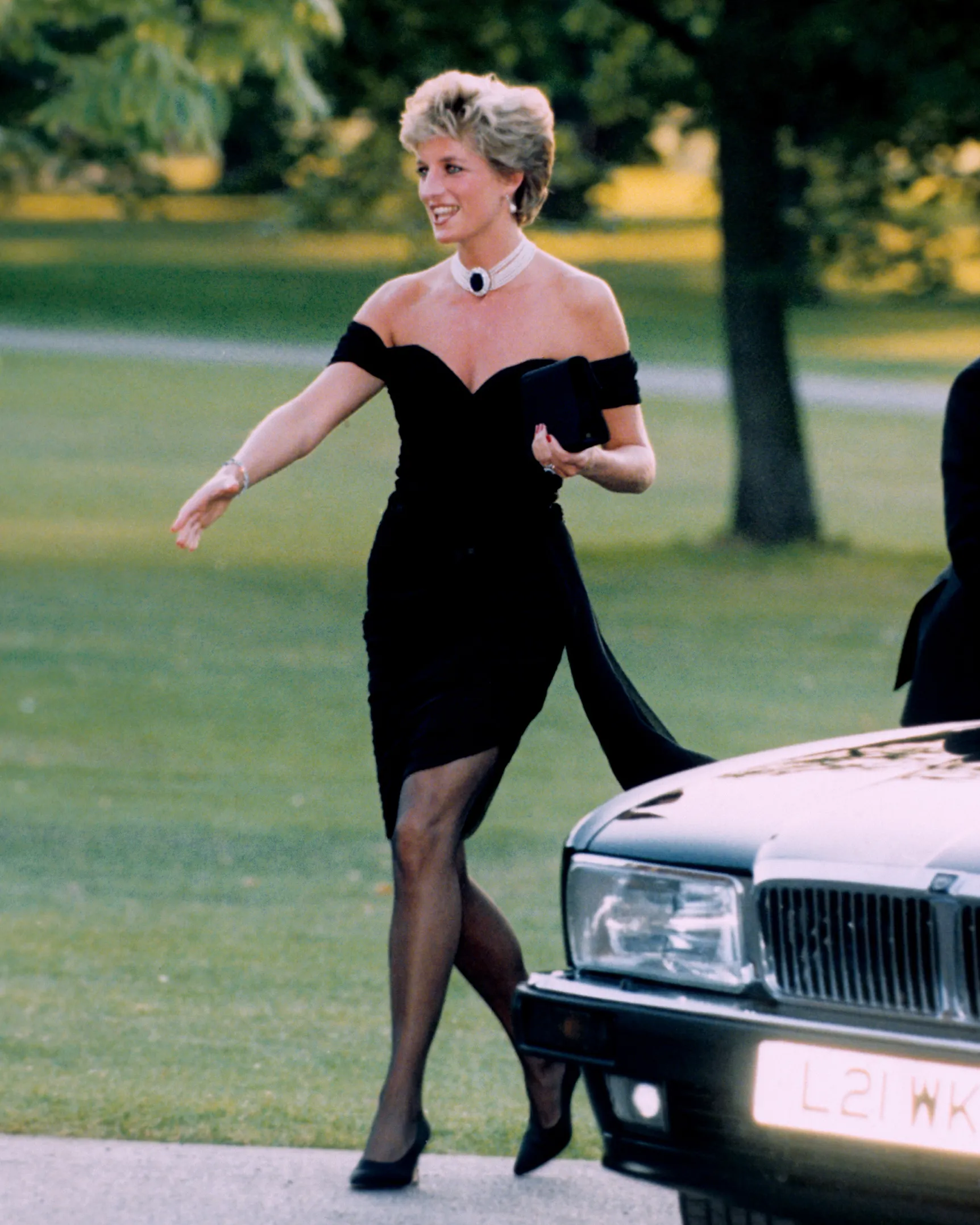
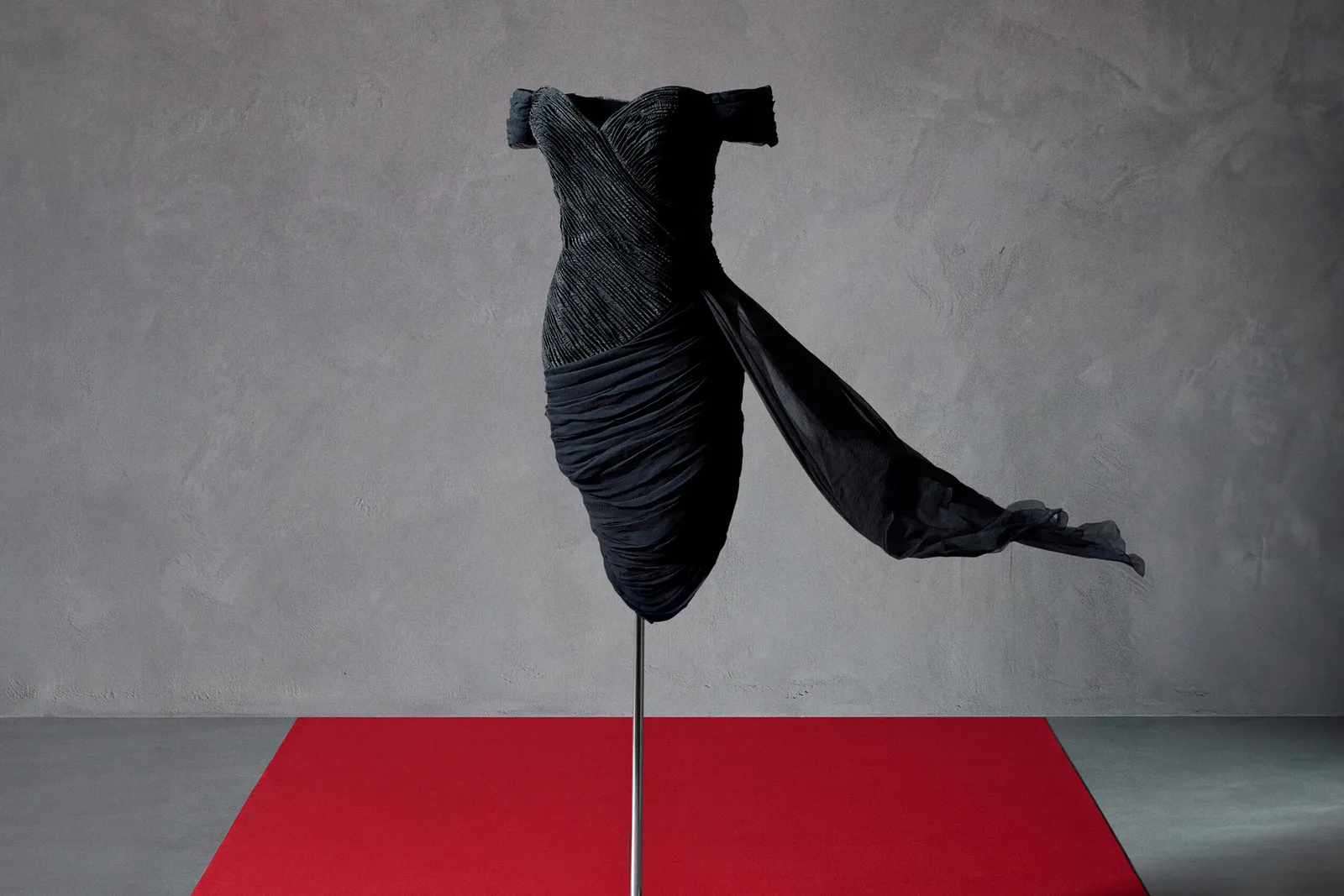
Among those not watching the broadcast on that summer’s evening was the Princess of Wales. She was, instead, attending a gala for the Serpentine Gallery, in Kensington Gardens, of which she had become a patron. (She wasn’t interviewed for the film, though, in an unrelated video recording that was later made public, she once gave a differing account of Charles’s attitude to his marital obligations: “He said, ‘I refuse to be the Prince of Wales that never had a mistress.’ ”) Diana usually expressed herself through symbolic gestures rather than tortuously constructed sentences, and her choice of outfit for the Serpentine gala was proof of her instinct for iconography. The dress—designed by Christina Stambolian, whom she had met while out shopping with her younger brother, Charles, the ninth Earl Spencer—had languished unworn in Diana’s wardrobe for three years. Fashioned from pleated silk, it featured an off-the-shoulder neckline, a plunging décolletage, a tight bodice, and an asymmetrical hemline cut well above the knee, with a chiffon sash. Seen in motion as she strode past the cameras, the garment’s labile folds evoked the classical draperies of Diana’s namesake goddess, albeit in movie-star black.
After years of wordlessly revealing her misery through her unmissable weight loss, hunched posture, and occasional tears, Diana materialized that evening in a different form: potent and gleaming, in high heels and semi-sheer black tights, around her neck a pearl choker incorporating a monster diamond-and-sapphire brooch that had been a wedding present from Charles’s grandmother, the Queen Mother. The garment was swiftly and indelibly described by the press as Diana’s “revenge dress.” Whatever the complexities of Diana’s early-nineties, post-separation existence, the dress seemed to suggest that its wearer (still, crucially, the wife of the next King and the mother of the one after that) was living her best life, though we didn’t yet use that expression. It was an outfit that seemed calculated to make any observer wonder what sort of man would choose Camilla—with her habit of tweedy, outdoorsy, utilitarian dressing—over this vibrant, glamorous beauty.
A little more than three years later, the Princess died in a late-night car crash in Paris; now, as we approach the thirtieth anniversary of that occurrence, a wave of Diana-related memoirs, documentaries, and other events is mounting. In September, Charles Spencer published a memoir, “Swan Song,” in which, controversially, he recalls that Charles had sounded “giddily elated” during a phone call the morning after the crash, and in a later conversation about funeral arrangements, told Spencer of his sister, “We’ll forget her soon enough.” (“His Majesty is mindful that the pain of fraternal grief can cloud reason, affect judgment and colour memory in ways others do not recognise,” a Palace spokesperson commented, in a statement.) Prince Harry is said to be sounding out potential interviewees for his own prospective documentary, though other key players in the story may be less than eager to sit down with the best-selling author of “Spare.” Sotheby’s in New York is getting a jump on the anniversary action by offering the revenge dress itself in a special auction in December, after an exhibition tour through London, Hong Kong, and Geneva. The garment was one of seventy-nine that Diana offered in an auction at Christie’s in June, 1997, to raise funds for AIDS and cancer charities; it is now being sold by a Scottish couple named Graeme and Briege Mackenzie, who had purchased it for around sixty-four thousand dollars. The current presale estimate of between a hundred and fifty thousand dollars and three hundred thousand dollars is confidently expected to be smashed when the dress comes under the hammer.
Viewers who stuck with the Prince Charles documentary on the evening that Diana gave the dress its electrifying début will have seen, a few minutes after his confession of infidelity, footage of the Prince and the Princess seated, a few places apart, at a memorial concert. Held in 1993 at Buckingham Palace, it was for Ruth Roche, Baroness Fermoy, who was Diana’s maternal grandmother and a former lady-in-waiting to the Queen Mother. As a chamber orchestra plays the slow movement of Bach’s Double Violin Concerto in D Minor, both parties to the marriage appear utterly miserable—appropriately enough for the occasion, though the editing suggests that the personal and constitutional crisis caused by their marital incompatibility is the real source of anguish. In a voice-over, Charles delivers a still resonant aria about the difficulties that marrying into the Royal Family presents. “They’re put into positions which they were simply not trained for, and the strains and stresses of that become, in some cases, almost intolerable,” he says. “And suddenly joining this organization in which I have been brought up, and my family have in a particular way, to see things in a particular way, is not the same as other people have, and it does add very real strains.” He goes on, “I think it’s personally going to become incredibly difficult. Just look at the level of intrusion, persistent, endless carping, pontificating, criticizing, examining, inventing the soap opera, constantly trying to turn everybody into celebrities, and if you’re not a celebrity, then, you know, what’s the point?”
One figure who has, to a large extent, escaped the pressure to embrace the culture of celebrity is, of course, the former Camilla Parker Bowles. In the course of the past three decades, she has seen a transformation from the unsought position of reviled Other Woman to that of Queen. This is a role for which she was, if not trained from birth like Charles, then clear-sightedly prepared from middle age. She is, to all appearances, contentedly married to the monarch, whose interests she shares and whose foibles she surely accepted long ago. She performs a sufficient, if not excessive, number of public duties, including being rained on last week in Antigua while on an official tour of the Caribbean. She is besieged neither by the tabloid press nor by the public. She is distinguished as neither the most nor the least popular royal. Charles need make no apologies for her. She is, like the King himself, part of the nation’s furniture: reliably enduring or appallingly out of date, depending on your point of view. One could even say that Queen Camilla is—despite never having worn a memorable dress in her life—avenged. ♦