

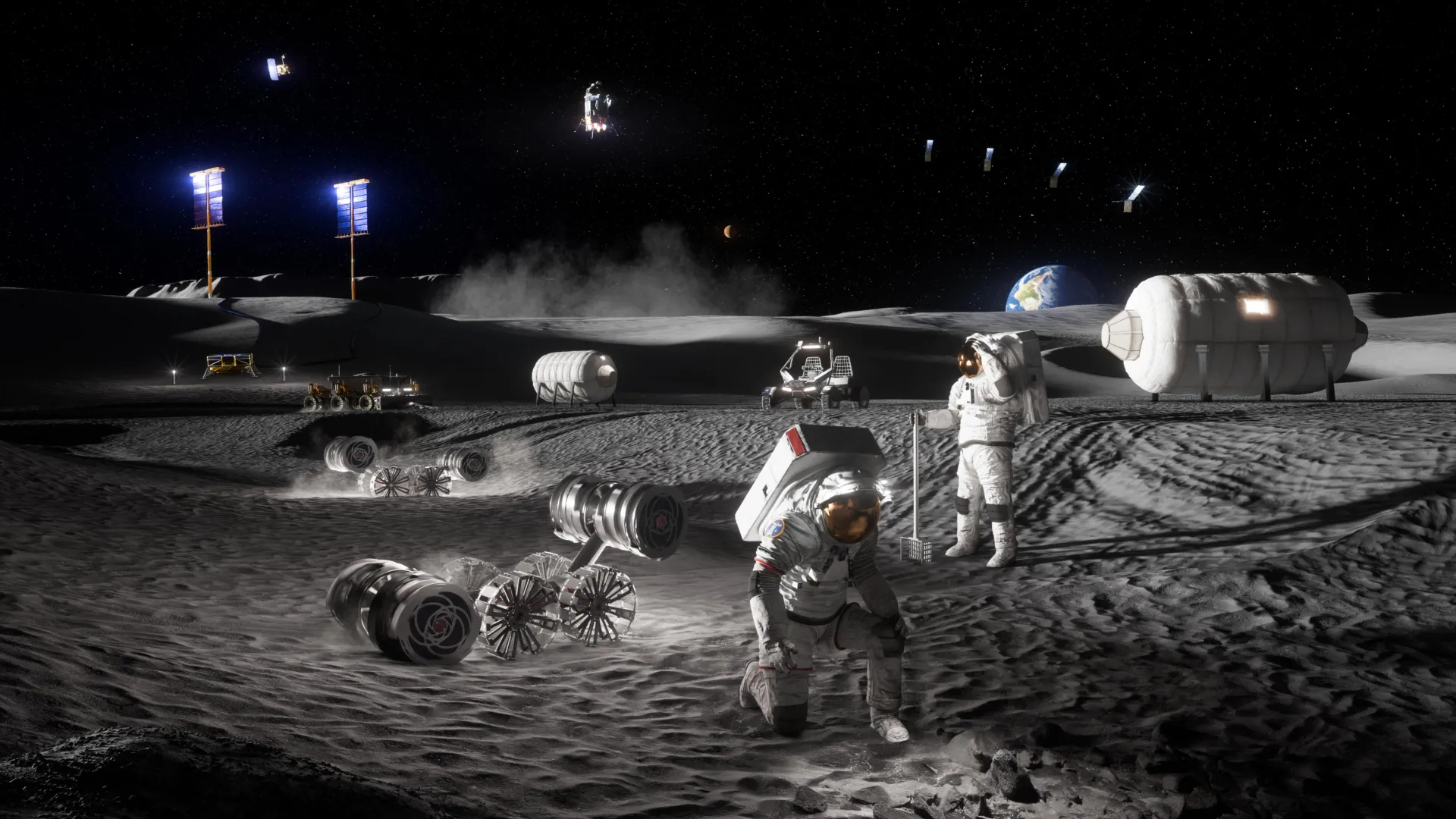
NASA has launched a $1 million Moon Base Challenge, inviting teams of students from high schools and colleges across the United States to help develop ideas for humanity’s future on the Moon. The competition was announced during a MAX POWER event at Kennedy Space Center Visitor Complex in Florida. Presented as part of a Golden Age of Science, the initiative gives young innovators an opportunity to contribute designs and potential solutions for NASA’s planned lunar base.
“We’re looking for students ready to think creatively, work as a team, and take on real problems connected to NASA’s future on the Moon,” said NASA Administrator Jared Isaacman. “You do not have to wait until graduation to contribute. Curiosity, creativity, and the willingness to tackle hard problems without obvious answers are exactly the qualities we need as we build what comes next.”
NASA’s Plans for a Permanent Moon Base
NASA is working toward establishing a Moon Base near the lunar South Pole, where astronauts will be able to live, conduct research, and explore the surrounding region. Creating a lasting human presence on the Moon is also an important step toward future missions that will carry astronauts to Mars. Achieving these goals will require expertise and creative thinking from people across a wide range of industries and disciplines.
“As we build and design the foundations of Moon Base, we want to leverage all the ingenuity and innovation to think of every consideration our explorers might need to live and work there,” said Carlos García-Galán, manager, Moon Base Program. “Students bring exactly the bold ideas that we’re looking for, and I’m looking forward to their fresh perspective. Ultimately, Moon Base is for them, people who will experience a world where humans are on the Moon to stay.”
Six Major Challenges of Living on the Moon
The competition will unfold in multiple phases, with student teams developing solutions to six essential aspects of operating a lunar base. These include generating and storing power, constructing facilities, maintaining life support systems, enabling transportation across the lunar surface, establishing communications networks, and protecting astronauts.
Each category addresses practical obstacles that NASA must overcome to support long-term operations on the Moon. By working on these problems, students can explore new approaches to lunar technologies while developing technical and professional skills that could prepare them for careers in aerospace and related fields.
The challenge is designed around actual environmental conditions and mission requirements that would affect daily life and operations on the lunar surface. Participants will produce work similar to that used in the space industry, including evaluations of competing technical options, proposals outlining potential designs, and presentations for project stakeholders.
Students from technical, vocational, and other academic backgrounds are encouraged to participate. Previous specialized knowledge of engineering or related technical fields is not required, making the competition accessible to a broad range of young innovators.
Inspiring the Next Generation of Space Explorers
Beyond generating ideas for the Moon Base, NASA hopes the competition will help develop the skills needed by the next generation of aerospace professionals. By exposing students to practical design challenges, the agency aims to encourage collaboration, creative problem-solving, and greater involvement in future space exploration.
“Students are the next generation of explorers and innovators. Their unique perspectives are key to helping us envision a future away from Earth, and I’m excited to see the creativity and ingenuity spurred by this challenge,” said Elaine Ho, associate administrator for the Office of STEM Engagement at NASA Headquarters.
How to Enter NASA’s $1 Million Moon Base Challenge
Interested student teams must register through the NASA STEM Gateway. Registration remains open until January 25, 2027.
NASA’s Office of STEM Engagement developed the competition in partnership with the agency’s Moon Base Program. The Institute of Competition Sciences is responsible for administering the challenge under a contract with NASA’s Center of Excellence for Collaborative Innovation, which operates within the Research and Technology Mission Directorate.